
Most publishers I talk to are buying the same AI strategy. Almost none of them should.
The strategy comes packaged as a checklist. Pick a content tool. Train an in-house model. Add a chatbot to the homepage. Run a few experiments. Put “AI-powered” on the marketing site. Repeat at the next conference. What looks like preparation is closer to motion that resembles progress while the actual ground shifts somewhere else entirely.
The publishers who survive the agent era will not be the ones with the best AI strategy. They will be the ones who do not need one. The reasons are structural, and they have very little to do with AI itself.
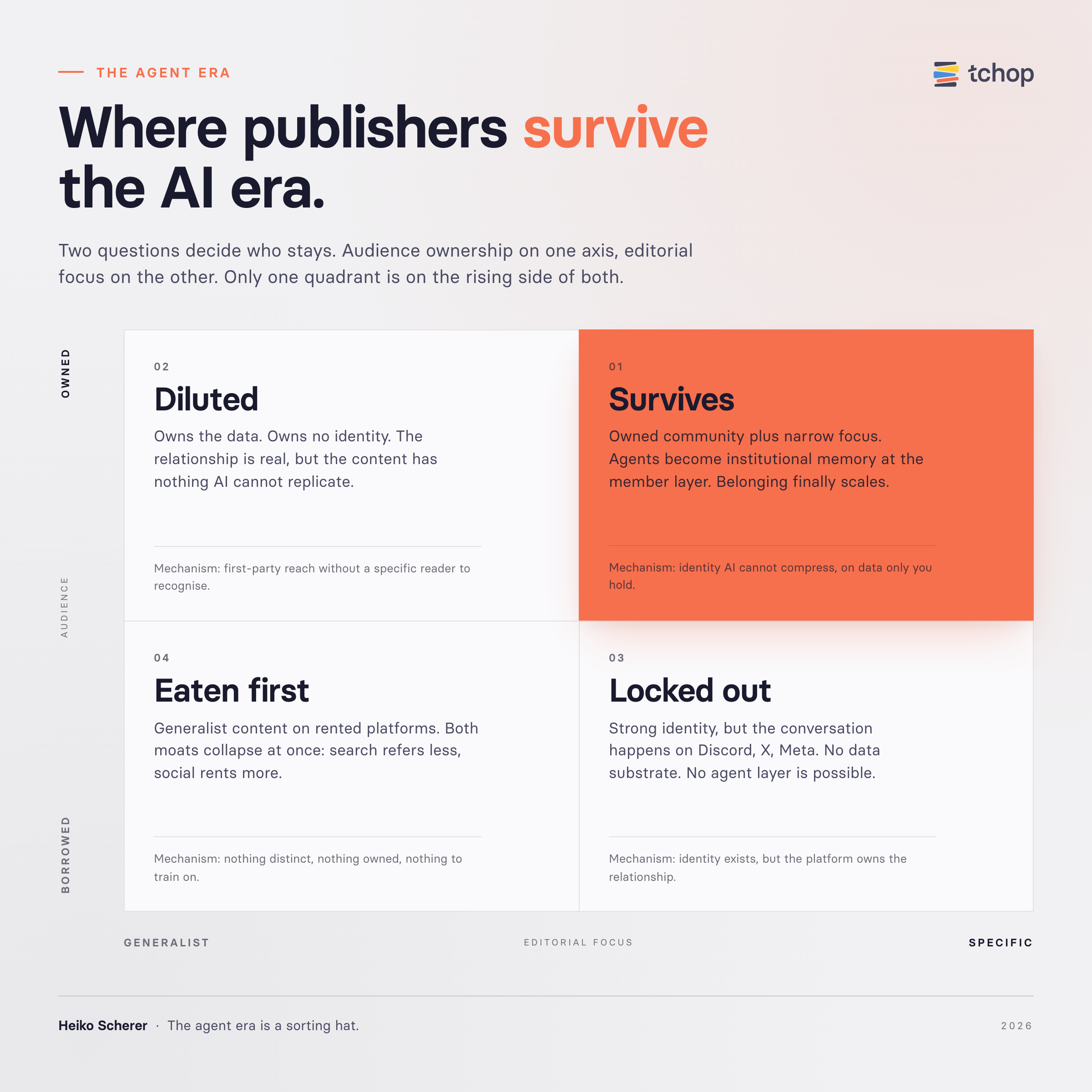
Two questions decide where a publisher lands on the chart above. Who owns the relationship with the audience? And how specific is the editorial focus? The answers, in combination, determine whether a publisher is sitting on assets AI raises in value or assets AI destroys.
What follows is five things the current AI-and-publishing conversation has backwards, and what the rising-side quadrant actually looks like up close.
AI commoditizes content. Identity is the only thing it cannot replicate.
ChatGPT will summarize, rewrite and translate any article in any voice in seconds. Whatever moat existed in “we have the information” is gone. Inputs that took years to build are now compressible. Beat reporting, archive depth, editorial judgment expressed at the article level. All into a paragraph, by a tool the reader already has open in another tab.
What is not compressible is identity. A specific group of recognisable people who gathered around a specific point of view. That is the only asset on a publisher’s balance sheet AI cannot replicate.
Generalist publishers, whose value was being-findable, get eaten first. Identity-driven publishers, the ones that are focused and narrow and recognisable to their own readers, get eaten slowest. Their value was never the article. It was the room the article happened in.
This is the layer most AI conversations are missing. Everybody is talking about how publishers should use AI. The harder question is which publisher assets AI raises in value and which it destroys. Identity is one of the very few items on the rising side of that line.
Agents change the unit of distribution from page to query
Most publishers measure the world in pageviews. Sessions. Time on site. Two decades of search and social trained a generation of editorial teams to optimise for being-found and then being-read.
Agents change the unit. They extract answers and never deliver the visit. Every “AI Overviews will eat your traffic” panic is a panic about distribution dependency, not about AI. Publishers whose readers come directly because they are members do not have SEO traffic to lose. Publishers whose only relationship with the audience is mediated by a search box are about to discover what the relationship was really worth.
Owned communities are no longer a nice strategy on the long list of growth options. They are the only revenue model structurally immune to the agent transition. The publishers who built that infrastructure between 2018 and 2025 are quietly collecting the upside right now. The ones who put it off are about to find out why “we have great SEO” was never a community strategy.
The interesting agent opportunity is not AI writing your articles
Most publisher AI conversations get stuck on generation. Will AI write our headlines? Should it draft our newsletters? Can it summarize our archive?
These are conversations about a feature. The interesting question is what an agent can do that no other tool has ever been able to do for a publisher.
The answer is institutional memory at the member layer.
A focused publication has years of conversations, archives, member context, voice. An agent trained on that owned data can answer any member’s question, in the publication’s voice, with the publication’s facts, in seconds. Call it the editorial DNA of the publication, available to every member, at scale, all the time. It is the thing publishers have always wanted to do for their best readers and never been able to afford.
Three preconditions make this possible.
- The domain is narrow enough for the agent to be a specialist. Generalist publications produce generalist agents that lose to ChatGPT on every measure that matters.
- The data is owned. Not on Discord, not in a Substack server, not in someone else’s CMS export.
- The voice is strong enough that the agent has something specific to speak in.
Each of these preconditions is also a precondition for community. Agents are the highest-leverage downstream consequence of having done the focus work, not a separate strategy that has to be managed alongside everything else.
Borrowed-platform “communities” cannot have agents
The owned-versus-rented argument has been made many times in publishing. Until now, it was about reach risk. Discord changes its terms. Twitter pivots. Meta throttles. Owned was the safer position because the platform could always pull the rug.
Agents change the framing. You cannot train an agent on conversations you do not own. You cannot give it member context Discord will not share with you. You cannot fine-tune voice on a corpus that lives in someone else’s database.
The publishers who get to build a useful AI layer in 2027 are the ones who own the conversation in 2026. Everyone else is locked out. Not by policy. By physics. The data substrate the agent layer needs simply does not exist on borrowed platforms, no matter how active the community on them is.
This makes “stop building on borrowed platforms” a sharper argument than it used to be. A publisher running their community on Discord or Facebook Groups is not just renting reach. They are forfeiting the only AI moat they could have had.
Agents finally let small, focused publishers scale belonging
The structural problem with community-led publishing has always been the same. Editorial intimacy does not scale. Two writers can know two thousand readers. They cannot know fifty thousand. So the model breaks above a certain size, or it stops feeling personal at the size where the economics start to work.
Agents change the math. A two-person publication can run an agent that knows every member, remembers every interaction, addresses each one in the publication’s voice. The intimate, identity-rich quality that used to require manual relationship-keeping becomes infrastructure.
This is where AI is genuinely accretive to community publishers and genuinely destructive to platform-mediated ones. Platforms have the scale but not the identity. Small publishers have the identity but, until now, not the scale of intimacy. Agents collapse that asymmetry. For the publishers who own the substrate.
The question publishers should be asking
The dominant industry question is “how do we use AI?” That is not the right question.
The right question is which publisher assets AI raises in value and which it destroys.
Owned community is on the rising side of that line. So is editorial focus, narrow audience identity, first-party data, and a voice strong enough to be recognisable. Almost everything else, generic content, SEO traffic, ad-funded scale, platform-rented reach, is on the falling side.
If a publisher already lives in the rising-side quadrant of the chart, the AI strategy is downstream. The agent layer is the natural next thing to build, and the hard work is already done. If a publisher is in any of the other three quadrants, no AI feature will fix the position. The strategy is to get focused, get owned, or get out of the way of publishers doing both.
That is the part of the conversation the industry is not yet having out loud. It is about to.
What the rising-side quadrant looks like with tchop
We built tchop for the publishers who already chose, or want to choose, the rising-side quadrant. Owned community space, native mobile apps, first-party member data, editorial voice the publisher controls end-to-end. The agent layer arriving next is the natural extension of an architecture designed around owned identity and narrow focus from the start.
If you want to see what an owned community looks like for your audience, built around your editorial voice, your member context, your data, book a 20-minute demo or get a demo video with your own app. We can show you what the rising side of the line looks like with your name on it.