
Most publishers I talk to have a community strategy. Few of them have a mobile strategy. They have not noticed those are the same strategy.
The conversation in publishing right now is the engagement conversation. Direct relationships. Community-driven products. First-party data. Subscriptions. Membership. All correct. All necessary. All incomplete in the same way.
Every one of these conversations skips the channel question. Where does the engagement happen? Where does the community gather? Where does the relationship live? The answers most publishers default to are still the homepage, the newsletter, maybe a Discord, and the app as an afterthought. This is the wrong list.
The right list has one item at the top.
Habits do not live on the web
Web requires intent. The reader has to open a browser, find a URL, and decide to read. The publisher’s job is to be remembered at the moment the reader has that intent. That worked when search delivered the audience and the homepage was the entry. It works less every quarter as agents extract answers and bypass the visit.
Newsletter requires inbox attention. Inbox attention is collapsing under the weight of every other newsletter, every other tool’s notification, every other transactional message. Newsletter is still useful as a recurring nudge. It does not build habit. It competes for it.
Mobile is the only consumer channel that lives ambiently. The app icon sits on the home screen. Push has explicit per-user permission. The reader opens the phone fifty times a day. The friction to enter the publication is one tap. The friction to leave is also one tap, which is why the experience inside the app has to be good. But the entrance is paid for, and once it is paid for, habit is the natural physics of the device.
This is not a preference. It is how the consumer attention market actually works in 2026.
Every platform that won attention won it on mobile
Instagram launched mobile-only and had no web product for years. TikTok is mobile-native and the web version is a screenshot tour. Snapchat refused to make a web product on principle. Reddit’s growth came when the app finally caught up to the web product, not before. Discord is a desktop app that grew up on mobile in a way the desktop-only users still do not appreciate. X has a web client but the addiction lives on mobile.
These are not coincidences. They are the same observation, repeated for fifteen years, in every category of consumer software that learned what habit means. The category that did not learn the lesson is publishing.
The gap between how modern consumer businesses build and how publishers build is now wider than the gap between TV and newspapers in 1995. The publishers who lose the next decade will be the ones who built for the medium of last decade. The publishers who win it will be the ones who treat mobile as the venue, not as a derivative channel for content made for somewhere else.
Most publishers run mobile as the office plant
Walk into a publisher with “mobile strategy” on the org chart and you will find the same thing in nine cases out of ten. A small team. A budget that rounds to zero in board reports. A few features bolted onto a CMS that was designed before iOS existed. Push notifications, treated as the entire mobile use case. An app that mirrors the website with a worse navigation. A roadmap where mobile is item six in a list of fourteen.
The mobile strategy is the office plant. Present. Occasionally watered. No business case attached.
The same publisher will spend twenty meetings a quarter on community. On retention. On membership. On lifetime value. None of those meetings include the word mobile, except as a footnote, except as a “yes we know we should.” The community discussion proceeds as if community were a thing that could happen anywhere, any time, on any surface, as long as the editorial intent is right.
Community does not work that way. Community needs a room. Web is a hallway. Newsletter is a postcard. Mobile is the only room a publisher can build that is theirs, ambient, identified, push-permissioned, and capable of holding a conversation that continues across days. Treating that channel as a side project while talking about community is a contradiction that costs.
Community is mobile-native or it is not community
What community needs in practice: discover, browse, react, post, message, get pushed when something matters, watch threads continue, show up tomorrow and find the people you were talking to yesterday.
What each channel can deliver natively:
- Web. Discover and browse, badly, with three open tabs and four cookie banners. The other actions are bolted on, if they exist at all.
- Newsletter. Notify. That is it. Reply-to-author works in a few cases. Everything else fails.
- Social. Discover, post, react, message. But the platform owns the relationship and the data. Reach can be rented and rescinded.
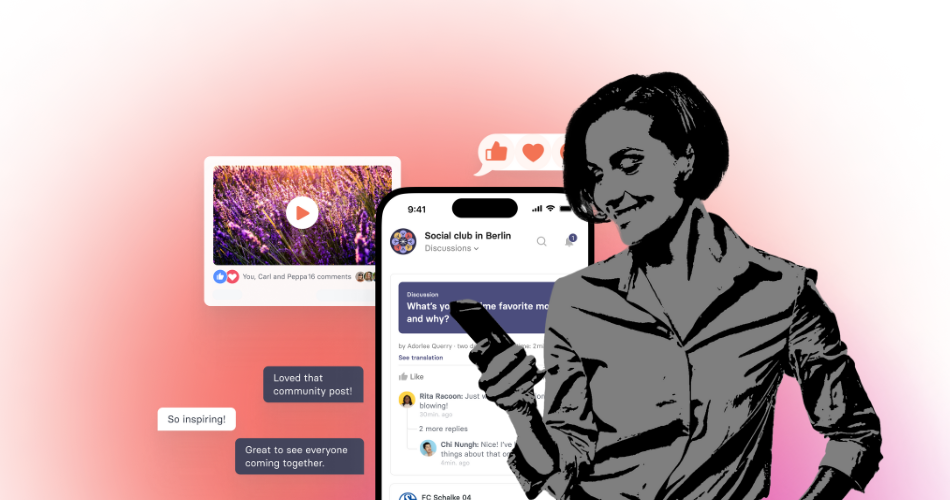
- Mobile app, owned. All of the above, in one room, with the relationship owned by the publisher and the data substrate growing every session.
If your community lives on Discord or in a Facebook group, the room is rented. If it lives on your homepage, the room exists only while the visitor is in it. If it lives in your newsletter, the room is the publisher’s outbox. None of these are the same as a place you own and your members return to.
There is one channel that delivers community as a native experience for a publisher. The fact that publishers refuse to invest in it at the level the rest of the consumer software world does is the reason their community strategies underperform their decks.
The agent era makes the mobile case unavoidable
We wrote last week about why owned community is the only quadrant on the rising side of the agent era. The argument was about data substrate, focus, and identity. Mobile is what produces the data substrate.
Web sessions are thin. They last a few minutes, the user is anonymous unless they have logged in, and the behavioral data is mostly about which article was clicked. Newsletter opens are anonymous to the publisher unless the user clicks a link. App sessions are different. Identified by default. Push-permissioned. Dense. Continuous across days, weeks, years. The dataset that comes out of three years of app usage by a focused community is the dataset an agent layer can actually do something useful with.
The publishers who run a serious mobile substrate now will have an order-of-magnitude richer data layer when they want to deploy member-serving agents in 2027. The publishers who do not will be locked out of the agent layer for the same reason borrowed-platform communities will be. Not by policy. By physics. The data will not exist.
This makes the mobile-as-office-plant strategy more expensive than it looks. It is not just lost engagement today. It is the foreclosed AI moat tomorrow.
The question publishers should ask
Stop asking how to grow your community. The growth question is downstream. The upstream question is where your community lives.
In 2026, the right answer is your app. With your editorial voice, your member context, your data, your push permissions, your push frequency under your control. Everything else is a partial substitute that does some of those things badly and most of them not at all.
If a publisher cannot answer the channel question with “our app,” the community strategy will plateau, the AI strategy will fail, and the next decade of consumer attention will be spent watching the categories that took the lesson.
What this looks like with tchop
We built tchop because we have watched publisher teams burn three quarters and a million euros trying to ship a native mobile experience that reaches feature parity with what TikTok had in 2014. The mobile-as-software-project framing is broken. The right framing is mobile-as-platform-substrate, and the question is no longer “can we build it” but “how fast can we ship a real one.”
Tchop is the answer when the answer is “this quarter, not next year.” A native mobile app for your publication, with editorial voice, community, push, member identity, and the data substrate the next agent layer will need. Built around the publishers who already chose the rising-side quadrant of the agent era.
If you want to see what your audience looks like inside an app you actually own, book a 20-minute demo or get a demo video with your own app. We can show you what the channel question looks like with the right answer attached.