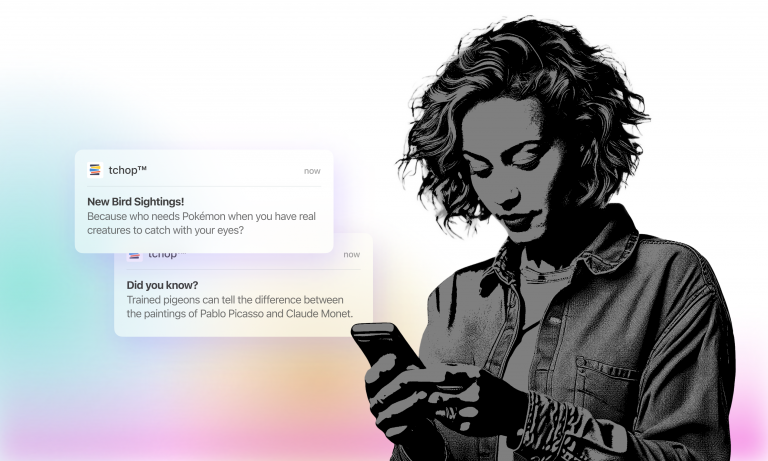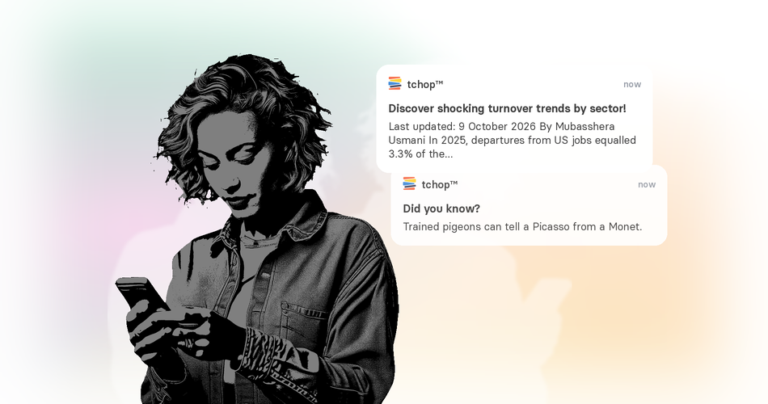

Use a push notification for everyday messages to people who have your app, and an SMS when the message has to reach a phone number whatever else is installed. A push notification costs nothing to send and needs an app, or a web app the person has allowed to notify them. An SMS costs money per message and needs none.
What is a push notification?
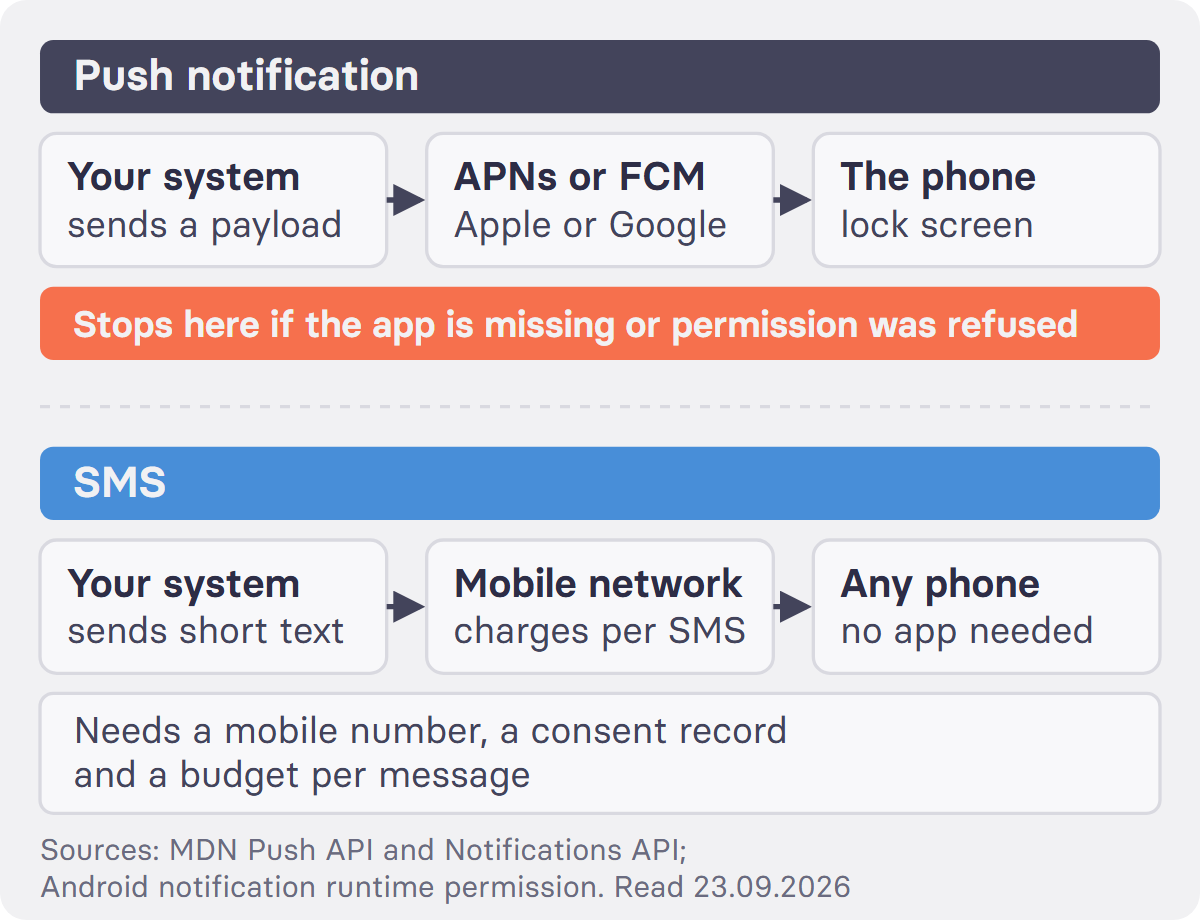
A push notification is a short message sent from a server to one device, shown on the lock screen or in the notification centre even when the app is closed. Two conditions have to be true first. The app has to be on the device, or the person has to use a web app that registered for push, which on iPhone and iPad means one added to the Home Screen, and the person has to have allowed notifications. The MDN Notifications API reference states the second one directly:
“In order to use notifications, the user needs to grant the current origin permission to display system notifications.”
MDN Web Docs, Notifications API, read 23 September 2026
What is an SMS?
An SMS is a short text message delivered by a mobile network to a phone number. It needs no app, no account and no internet connection, which is why it still works on a twelve-year-old handset in a basement with one bar of signal. It is also the only channel in this comparison that reaches somebody who deleted your app last week. In exchange, an operator charges for every message, and the message is plain text with a link at best.
Push notification or SMS: what actually differs?
| What you are deciding | Push notification | SMS |
|---|---|---|
| Needs an app on the device | Yes: an app, or a web app with push allowed (on iPhone and iPad, added to the Home Screen) | No |
| What each message costs | Nothing per message | Charged per message sent |
| What you need to send | A device token | A mobile phone number |
| Permission to send | Prompt on the device | Consent, and it is documented |
| What the message can hold | Title, body, image, deep link | Short plain text |
| Someone who deleted the app | Unreachable | Still reachable |
| Best for | Everyday news and tasks | Emergencies and first contact |
When is a push notification the right choice?
- The message is one of many. Daily and weekly traffic is what a per-message charge punishes and a push notification does not.
- You want the message to open something. A push notification can carry an image and a deep link straight to the item. An SMS carries a link and hopes.
- Your audience already has the app. The Push API is available to 96.27 % of tracked global browser use, counting full and partial support (Can I use, read 23 September 2026), and every current phone platform supports it natively.
When is an SMS the right choice?
- Nobody has installed anything yet. The first message in a rollout cannot be a push notification, because there is nothing to push to.
- The message matters more than the budget. A site evacuation, a shift cancelled at 04:00, a plant closed by a burst pipe.
- The audience is not yours to onboard. Contractors, agency staff and seasonal workers often never get an account at all.
What does this change for reaching a workforce rather than customers?
Almost every guide to this question is written about customers. Reaching your own staff changes two things, and both of them are constraints the marketing version never meets. The first is that permission is granted on the device and not by you. On Android, notifications have needed an explicit runtime permission since Android 13, which the Android developer documentation describes as a runtime permission called POST_NOTIFICATIONS. A workforce that taps “don’t allow” during onboarding is a workforce you cannot reach, and no amount of budget changes that. The second is co-determination. In Germany, introducing a system capable of monitoring behaviour or performance needs the works council’s agreement under §87 Abs. 1 Nr. 6 BetrVG:
“Einführung und Anwendung von technischen Einrichtungen, die dazu bestimmt sind, das Verhalten oder die Leistung der Arbeitnehmer zu überwachen”
Betriebsverfassungsgesetz §87 Abs. 1 Nr. 6, gesetze-im-internet.de, read 23 September 2026
Read delivery receipts and per-person open tracking are exactly what that clause is about. An SMS gateway raises the same question, so the answer is not to switch channel. The answer is to agree what is measured before the first message goes out.
One honest limit on this page: it is about reaching employees. If you are messaging customers, consent rules differ by country and by channel, and none of them is covered here.
Why the reach argument is not the same for every workforce
The case for messaging a phone at all rests on who has internet access for their work. Across the EU, 64.6 % of people employed in enterprises with 10 or more staff have internet access for business purposes, and in Germany 68.4 %. Break the German figure down and the spread is wide: 95.0 % in information and communication, 61.3 % in transport and storage, 60.6 % in construction, 39.2 % in food, beverage and tobacco manufacturing (Eurostat, isoc_ci_cm_pn2, 2025). Read those figures with their limit. The survey covers enterprises with 10 or more persons employed and excludes agriculture, mining, the financial sector and health and social work, so it says nothing about the smallest employers or about hospitals and care.
How does tchop handle push notifications for people without a work account?
tchop sends push notifications to a branded employee app, and browser push to its web app, both of which people sign in to without a company email address, with credentials from their employer or a sign-in link sent to a private address, so the channel works for staff who were never issued a work account. AOK, one of Germany’s largest statutory health insurers, runs its employee apps on tchop across several regional AOKs, where staff in branch offices and administration sign in through AOK’s own single sign-on instead. tchop does not deliver news or alerts by SMS and it is not an emergency alerting system, so a site evacuation still needs a separate channel that reaches a phone number.
See the tchop engagement tools and the glossary entry on push notifications.
Questions people ask
What are the downsides of push notifications?
Three. They reach only people who installed the app, or use the web app with push switched on, and allowed notifications, so your audience is smaller than your headcount. They are easy to switch off and hard to switch back on. And they invite overuse, because sending one costs nothing, which is the fastest way to teach a workforce to swipe them away without reading.
Is SMS becoming obsolete?
No, and its role has narrowed. SMS lost everyday conversation to chat apps years ago. It kept the jobs that need a message to arrive at a number with no app, no account and no data connection, which is why one-time codes, delivery notices and emergency alerts still travel that way.
Should push notifications be turned on or off?
For a work app, on, with the honest caveat that this is the employee’s decision and not the employer’s. The practical answer for the sender is to earn it. Ask for the permission at a moment when the value is obvious, such as the first shift change, rather than on the first screen after install.
Who sends push notifications?
The app’s own server, through the push service belonging to the operating system. Apple’s service handles iPhone and iPad, Google’s handles Android, and a web app uses the browser’s push service. Each of them delivers only for an app or website the person has allowed to notify them, which is why a stranger cannot push a message to a phone the way anyone with the number can send an SMS.
How do you reach employees who have no app and no work email address?
Start with what reaches a number, then move the traffic. A first SMS or a printed code gets the app installed, and the everyday traffic moves to push notifications once it is. tchop is built for that second step, and it does not replace the first one.