
In one week in October 2026, two intranet vendors announced that AI agents may now write to their platforms as well as read from them. Interact announced it on 20 October. Haystack switched it on for its customers on 26 October. A month ago, “our intranet has an MCP server” still sounded like a differentiator. It no longer is.
For internal communication teams this matters more than it sounds. Whether an agent can read your intranet decides how good the search box gets. Whether it can write to it decides whether your team gets time back.
This post explains the difference in plain terms, shows who offers what as of 27 October 2026, and gives you the questions to ask before your next intranet or employee app decision.
What an MCP server does for an intranet
MCP, the Model Context Protocol, is an open standard that Anthropic introduced in November 2024. It gives AI assistants such as Claude, ChatGPT or Microsoft Copilot one common way to connect to other software. The software offers an MCP server. The assistant connects to it and can then use whatever tools that server makes available.
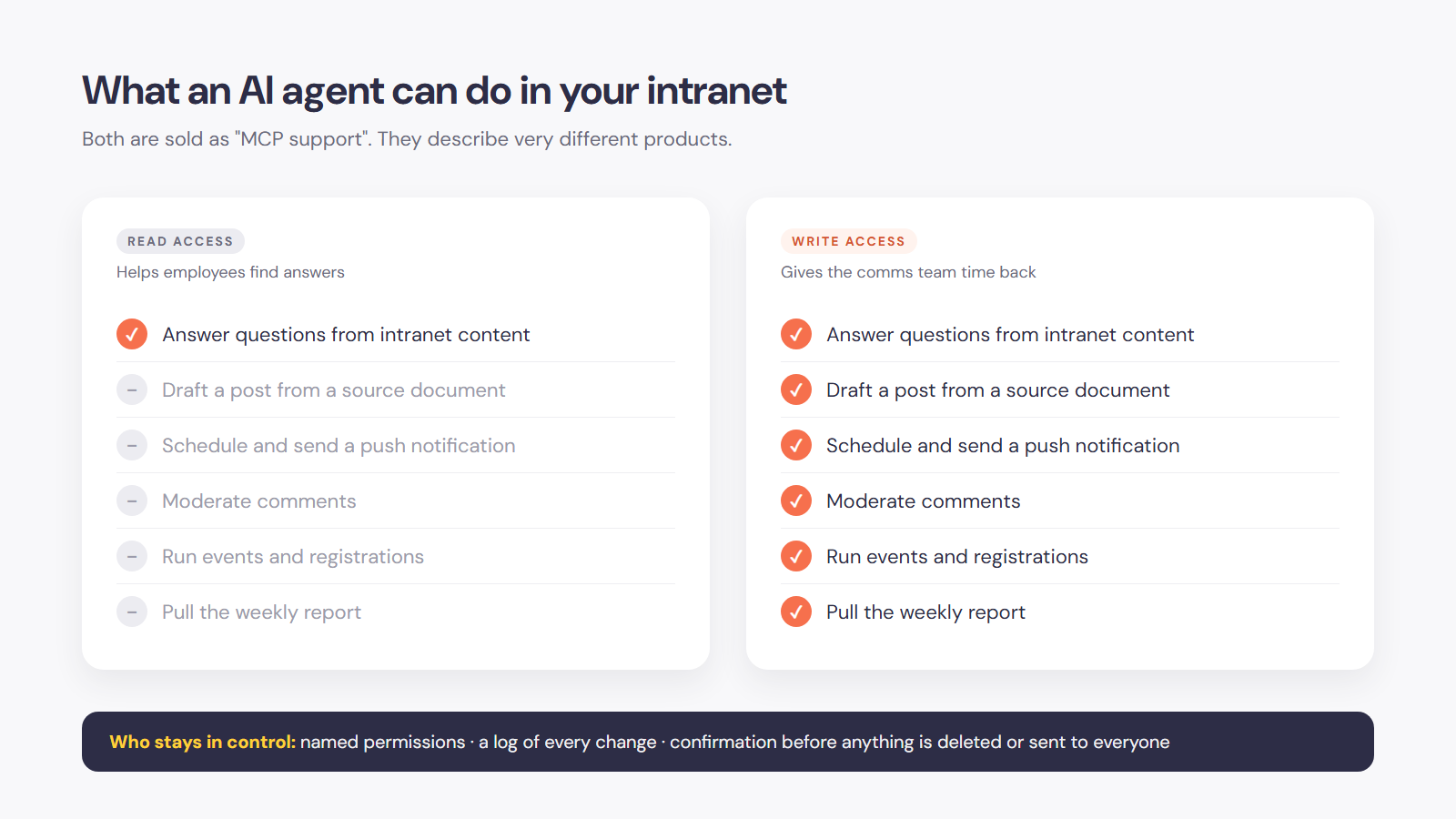
Those tools decide everything. If the server offers “search pages”, the assistant can answer questions from your intranet. If it also offers “create post”, “send push notification” and “hide comment”, the assistant can do part of your team’s work. Both are sold as “MCP support”. They describe very different products.
Read access vs write access: what changes for the comms team
Read access helps employees. Someone asks their assistant what HR announced about the new shift plan and gets the right answer, with a link to the source. That beats searching the intranet by hand, and it keeps official information visible even when people stop opening the intranet.
For the communication team, little changes. Every post still has to be written, scheduled, targeted and moderated by a person. The assistant can find last week’s announcement. It cannot prepare next week’s.
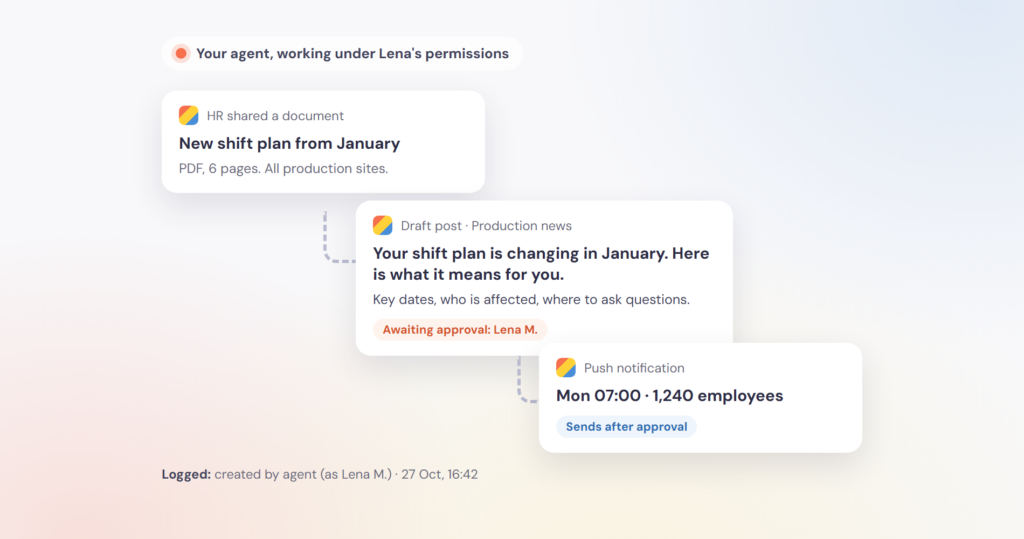
Write access changes the team’s day. An agent connected with write access can:
- turn an HR update or a press release into a post for the right channel
- schedule it and send the push notification
- reply to comments, or hide them, following your moderation rules
- set up an event with registration and a waitlist
- pull the weekly report on what was read and what was ignored
| Task | Read-only server | Server with write access |
|---|---|---|
| Answer an employee’s question from intranet content | Yes | Yes |
| Draft a post from a source document | No | Yes |
| Publish or schedule a post | No | Depends on the vendor |
| Send a push notification | No | Depends on the vendor |
| Moderate comments | No | Depends on the vendor |
| Manage events and registrations | No | Depends on the vendor |
| Pull analytics | Sometimes | Depends on the vendor |
“Depends on the vendor” is the honest answer, and it is the reason the next section exists.
Communicators want this help. In Gallagher’s Employee Communications Report 2025, based on a survey of more than 2,000 communication and HR professionals, eight in ten communicators were happy for AI to assist with content creation and copywriting. Only 41 percent said their organisation had guidance on which AI tools they may use. The appetite is there. The guardrails often are not.
Who offers what, as of 27 October 2026
| Vendor | What agents can do | Source |
|---|---|---|
| Staffbase | Read-only. The documentation states that AI agents can retrieve content but cannot create, edit or delete anything. Tested with Claude and Microsoft Copilot. | Staffbase support documentation, developer documentation |
| Haiilo | Described as a way to get trusted answers from company knowledge inside Copilot, Claude and Gemini. The feature page does not mention creating or editing content. | haiilo.com |
| Haystack | Read since August 2026. Write access from 26 October 2026 in Claude, ChatGPT, Copilot and Slack: an assistant can draft a knowledge page, or write a post for a group the employee may publish to, as a draft or published. Write access is optional per customer. | Press release, 22 October 2026 |
| Interact | Announced on 20 October 2026: agents can search, create, edit and act across the intranet, with 700 capabilities. General availability is planned for later in 2026. Built for large enterprises. | interactsoftware.com |
| tchop | Read and write across the editorial workflow: create and schedule content, manage channels and feeds, moderate comments, send push notifications, run events and pull analytics. More than 100 tools, in beta. | tchop knowledge base, developer portal |
Some vendors use MCP in the other direction. Flip’s Agent Gateway, for example, connects external systems such as SAP or Workday to Flip’s own assistant. That is useful for employees, and it is a different question from whether your own agents can operate the platform.
This table will age. Vendors are adding write access quickly, so check each one’s documentation on the day you compare them.
The three questions that matter now
Since write access is becoming normal, the useful comparison moves on. Three things separate the offers.
Breadth. Writing a post is the first step. Internal communication also means push notifications, events, moderation, personalised feeds and reporting. The more of that an agent can operate, the more work it can take off a small team.
Control. An agent should act with a named person’s permissions, not with a master key. Every change should appear in a log. Actions that are hard to undo, such as deleting content or sending a push to everyone, should need a person’s confirmation.
Whose agents. Some platforms give you their assistant. Others let you connect the agents your organisation already pays for and governs. The second option fits most companies’ AI policies better, because the rules you set for Claude or Copilot then apply to intranet work too.
Our view at tchop: the team doing the communication should be the one that gets time back, and it should stay in charge of what goes out. That is why we built our MCP server with write access from the start, and why every tool runs under the permissions of the account that uses it.
How tchop handles write access
tchop’s MCP server connects any MCP-compatible assistant, such as Claude, Cursor or Windsurf, to your tchop app. The assistant can then create and update cards of every type, and publish or schedule them across channels and mixes. It can moderate comments, send push and in-app notifications, run events and query analytics, all in plain language.
The controls are built in. An agent works with the rights of the account it uses, so a channel editor’s agent can only do what that editor can do. Change logs show who changed a card or an event, and when. Deleting anything requires an explicit confirmation. The server is hosted by tchop and currently in beta. The same operations are available as a stable GraphQL API for teams that prefer to build.
If you want the detail, start with the MCP server article in our knowledge base and the practical guide to the tchop MCP server. For the policy side, we wrote about how to build AI guidelines for your internal communications team.
Seven questions to ask any vendor
- Can our own agents create and change content, or only read it?
- Which tasks can an agent complete from start to finish: posts, push notifications, moderation, events, reports?
- Does the agent act with a named user’s permissions, or with admin rights?
- Is there a log of every change an agent made?
- Which actions need a person’s confirmation first?
- Can we connect the AI tools we already use, or only the vendor’s own assistant?
- Is write access available today, or announced?
Next step
If you are comparing platforms this quarter, bring these seven questions to every demo, including ours. Book a 20-minute demo and we will walk you through what an agent can do in a tchop app.
FAQ
What is an MCP server, in plain terms?
It is the part of a software platform that AI assistants connect to through the Model Context Protocol, an open standard introduced by Anthropic in 2024. The vendor builds the server once. Any assistant that supports MCP can then use the tools the server offers, with no custom integration for each tool.
Do AI agents replace internal communication teams?
No. In the setups described here, the agent prepares and carries out routine steps, and a person decides what goes out. The team’s judgement about what to say, to whom and when stays where it was. The time saved goes to the messages that need it.
How do AI agents help internal communication teams in practice?
Drafting posts from source documents, scheduling and sending push notifications, first-line comment moderation, setting up events, and weekly reporting. The exact list depends on which tools the platform’s MCP server exposes, which is why read-only servers help employees but change little for the team.
Which intranet and employee app vendors offer an MCP server?
As of 27 October 2026: Staffbase (read-only), Haiilo (answers from company knowledge), Haystack (read since August, write from 26 October 2026), Interact (read and write announced, general availability later in 2026) and tchop (read and write, in beta). Check each vendor’s documentation, because this changes month by month.
Is it safe to give AI agents write access to internal communication?
It depends on the controls. Check that agents act with a named user’s permissions, that every change is logged, and that deleting content or sending to everyone needs a person’s confirmation. Many teams start with low-risk jobs, such as weekly reports or draft posts, before handing over publishing.