
Last updated: 9 October 2026
By Mubasshera Usmani
Only 20% of employees worldwide were engaged at work in 2025, according to Gallup’s State of the Global Workplace 2026. That is the lowest level since 2020. The other 80% split in two: 64% are not engaged, giving their time but not their energy, and 16% are actively disengaged.
If you work in internal communication, that 80% is your audience. Below are ten current employee engagement statistics. Each comes with its source, year, sample size and country, plus a short note on what it means for the way you communicate.
At a glance
Key numbers
- 20% of employees worldwide were engaged in 2025
- 12% of employees in Europe are engaged, the lowest of any region
- 10% of employees in Germany feel a strong bond to their employer
- About $10 trillion in productivity was lost to low engagement in 2025
- 22% of managers worldwide were engaged in 2025, down from 27% a year earlier
Sources: Gallup State of the Global Workplace 2026 · Gallup Engagement Index Deutschland 2025
What is employee engagement?
Gallup describes employee engagement as reflecting “the involvement and enthusiasm of employees in their work and workplace.” In plain terms, it shows how attached people feel to their work, their team and their employer. Gallup measures it with the Q12, a survey of 12 statements about everyday working conditions.
Based on the answers, Gallup places employees in one of three groups:
- Engaged: highly involved in and enthusiastic about their work
- Not engaged: psychologically unattached to their work, giving their time but not their energy. Gallup calls this “quietly quitting”
- Actively disengaged: resentful that their needs aren’t being met, and acting on it. Gallup calls this “loudly quitting”
Engagement sets a higher bar than satisfaction or happiness. Satisfaction is about whether the job meets someone’s needs, and happiness is about how they feel. Someone can be satisfied with their salary and hours, and happy at work, and still do the minimum. Engagement captures how much people put into their work and how much they care about the result.
For a longer explanation, see our glossary entry on employee engagement.
10 employee engagement statistics for 2026
1. 20% of employees worldwide are engaged
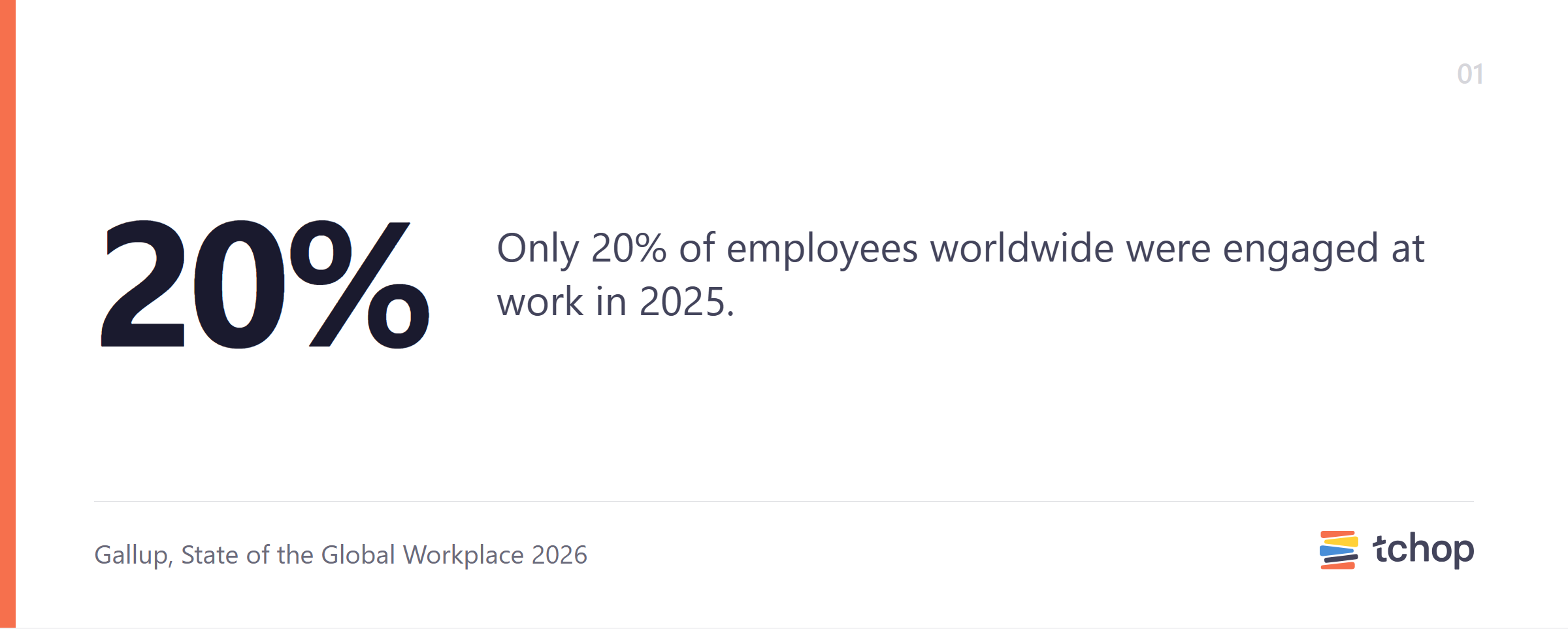
Global engagement fell to 20% in 2025, its lowest level since 2020. It peaked at 23% in 2022, held there in 2023, then slipped to 21% in 2024.
It is the first time global engagement has dropped for two years in a row, and no region of the world improved in 2025. To put the numbers in perspective, Gallup estimates that each percentage point represents about 21 million employees.
Source: Gallup, State of the Global Workplace: 2026 Report (published April 2026) · Data collected January to December 2025 · 263,810 respondents, including 141,444 employed people · 140+ countries and territories · gallup.com
2. 12% of employees in Europe are engaged, the lowest of any region
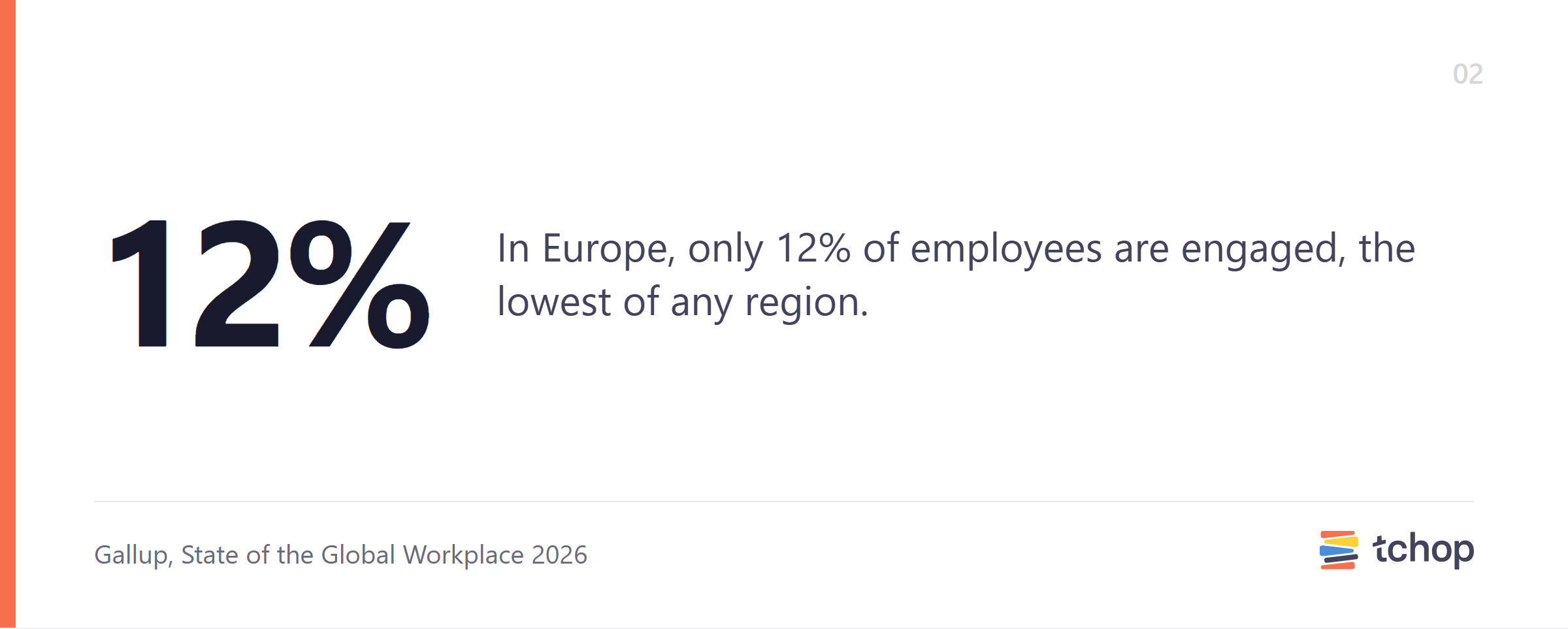
Europe has the lowest employee engagement of any world region, at 12%. In the United States and Canada, it is 31%. Across Europe, 73% of employees are not engaged and 15% are actively disengaged.
Since 2025, Gallup has reported regional figures based on three years of polling, which smooths out short-term swings.
Source: Gallup, State of the Global Workplace: 2026 Report, regional data (published April 2026) · Gallup World Poll data aggregated over three years · Europe · gallup.com
3. 10% of employees in Germany feel a strong bond to their employer
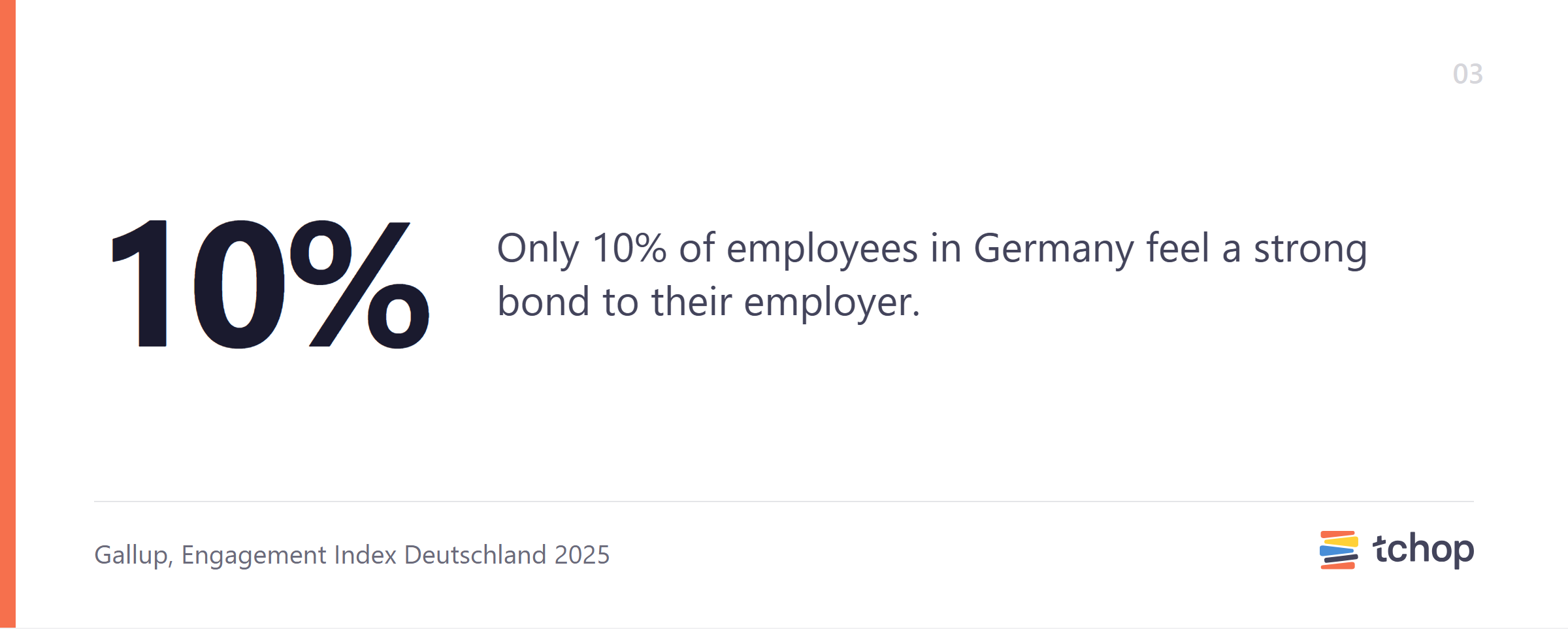
Gallup’s Engagement Index Deutschland 2025 finds that 10% of employees have a strong emotional bond to their employer, up from 9% in 2024. A large majority, 77%, have a weak bond: they get their work done but don’t go further. The remaining 13% have no bond at all.
Gallup calls this a stabilisation, though at one of the lowest levels since the index began in 2001. In Gallup’s German research, “emotional bond” is the equivalent of employee engagement.
Source: Gallup, Engagement Index Deutschland 2025 (published March 2026) · Survey period 17 November to 20 December 2025 · 1,700 randomly selected employees aged 18 and over, interviewed by phone · Germany · gallup.com
4. Low engagement cost the world about $10 trillion in 2025
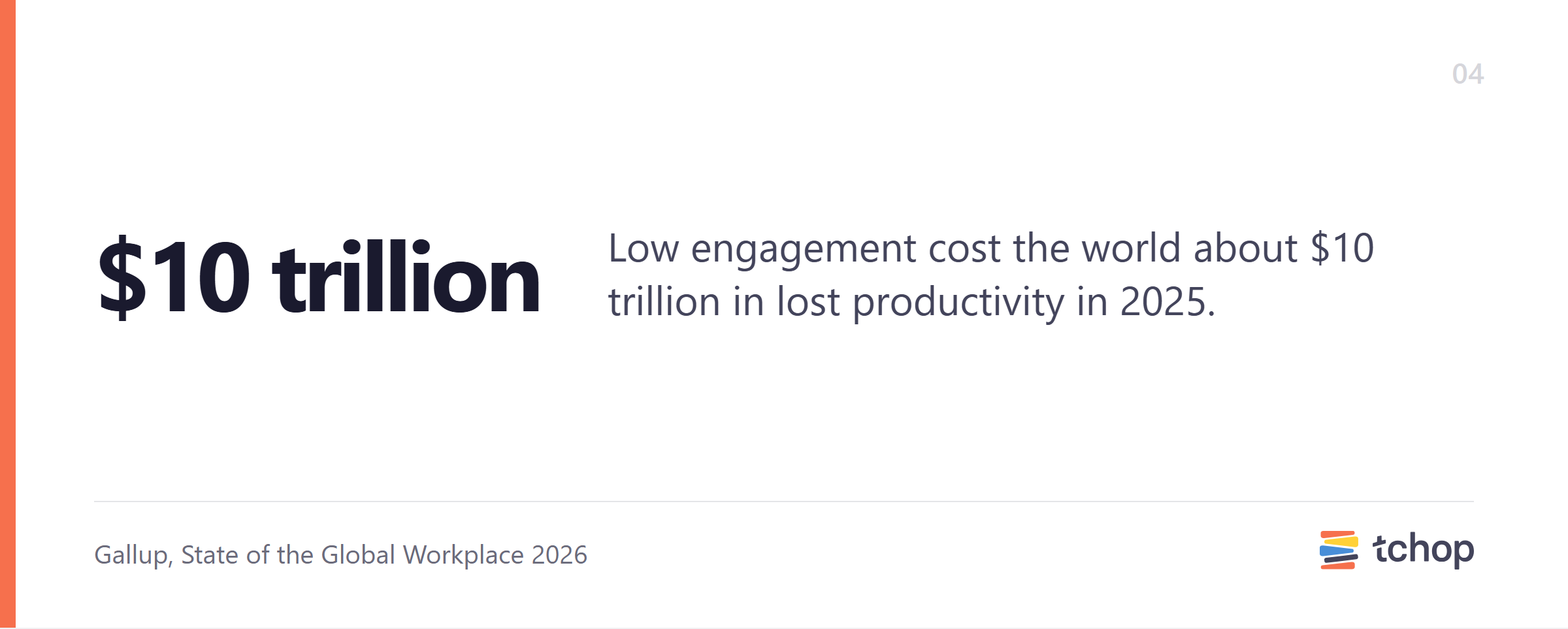
In Gallup’s words, “low engagement cost the world economy approximately $10 trillion in lost productivity, or 9% of GDP” in 2025. The section on the cost of disengaged employees below explains how Gallup calculates it and why it calls the figure conservative.
Source: Gallup, State of the Global Workplace: 2026 Report (published April 2026) · Data from 2025 · Global · gallup.com
5. Manager engagement fell from 27% to 22% in one year
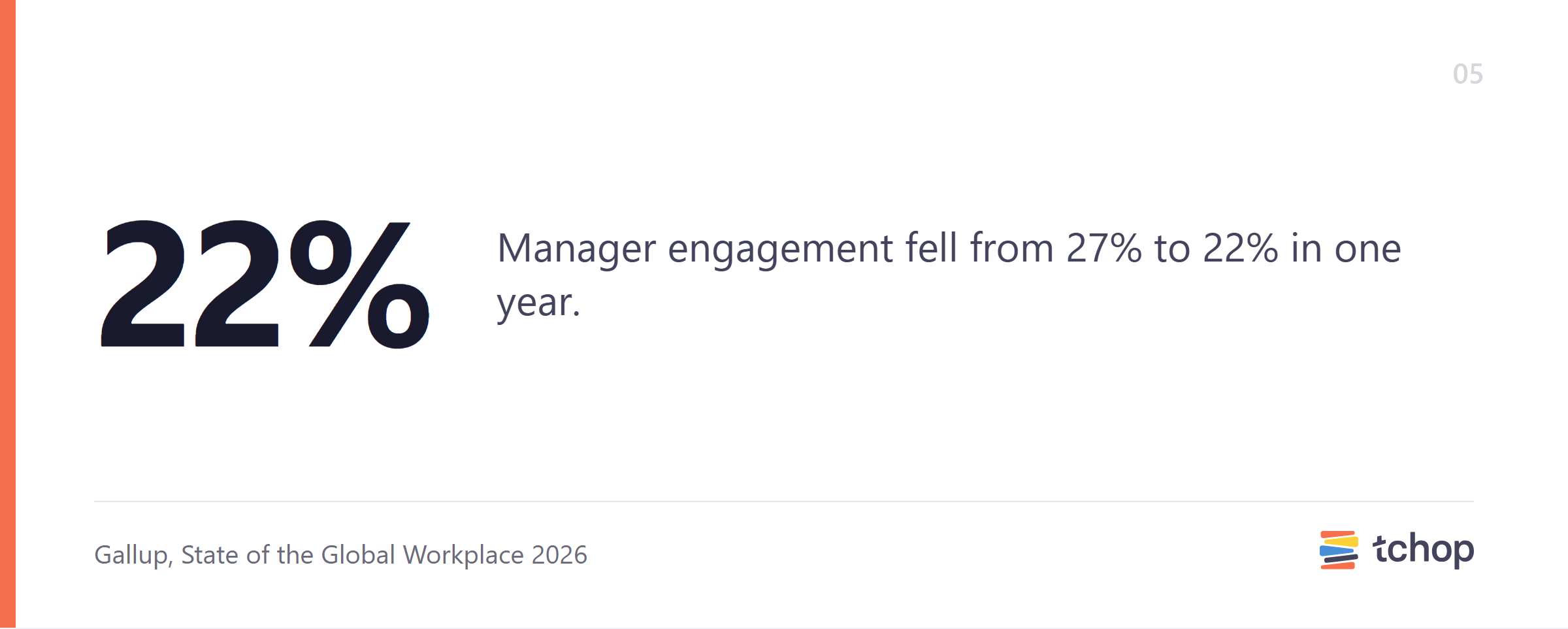
Global manager engagement fell from 27% in 2024 to 22% in 2025. Back in 2022, it stood at 31%. Over the same period, engagement among employees without management roles barely moved, standing at 19% in 2025.
According to Gallup, lower engagement among managers accounts for most of the recent global decline. Managers used to be clearly more engaged than the people they lead. Today, they are increasingly only as engaged as their teams.
Source: Gallup, State of the Global Workplace: 2026 Report (published April 2026) · Data from 2022 to 2025 · Global · gallup.com
6. Managers account for at least 70% of the variance in employee engagement
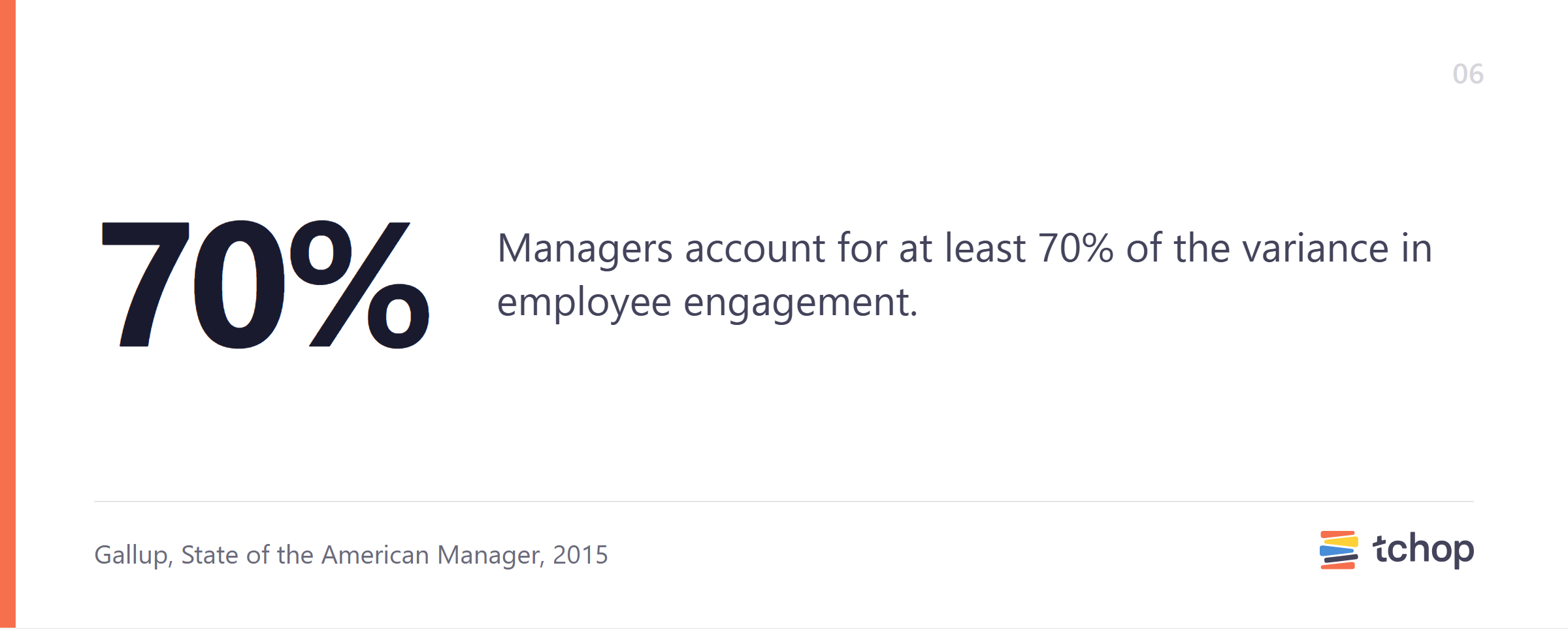
Gallup found that managers account for at least 70% of the variance in employee engagement scores. In other words, how engaged a team is depends largely on the person leading it.
The same research found that engagement is highest among employees who have some form of daily communication with their manager, whether face to face, by phone or digitally.
Source: Gallup, State of the American Manager findings (Gallup article, April 2015) · Based on 2.5 million manager-led teams in 195 countries and the engagement of 27 million employees · This is older research, included because it remains Gallup’s original source for the figure · Report page
7. The most engaged teams show 23% higher profitability
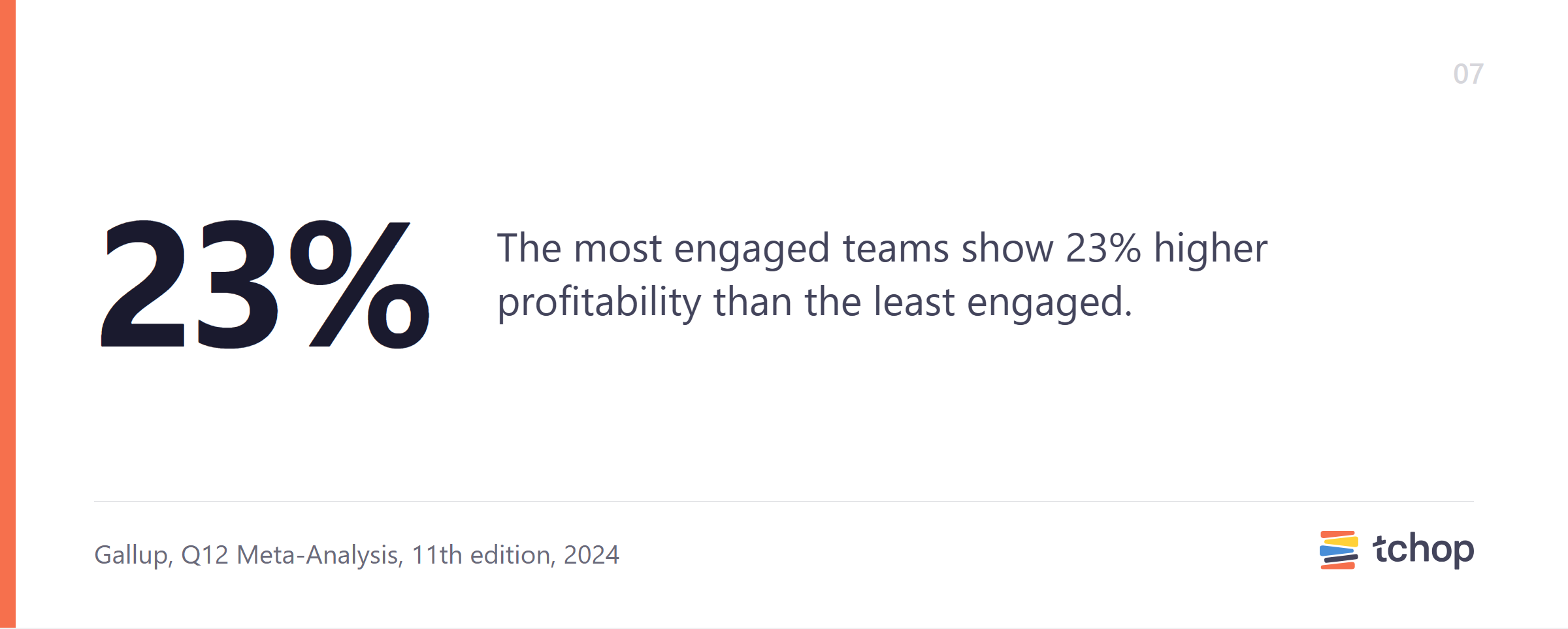
Gallup’s latest meta-analysis compared business units in the top quarter for engagement with those in the bottom quarter. It found median differences of 23% in profitability and 18% in productivity, measured in sales, in favour of the most engaged units. The differences were 10% in customer loyalty and 32% in quality defects.
Gallup describes it as the largest study of its kind. It combines 736 research studies from 347 organisations.
Source: Gallup, The Relationship Between Engagement at Work and Organizational Outcomes, Q12 Meta-Analysis, 11th edition (published May 2024) · 183,806 business and work units with 3,354,784 employees in 347 organisations across 53 industries · 90 countries · gallup.com
8. The most engaged teams have 78% lower absenteeism
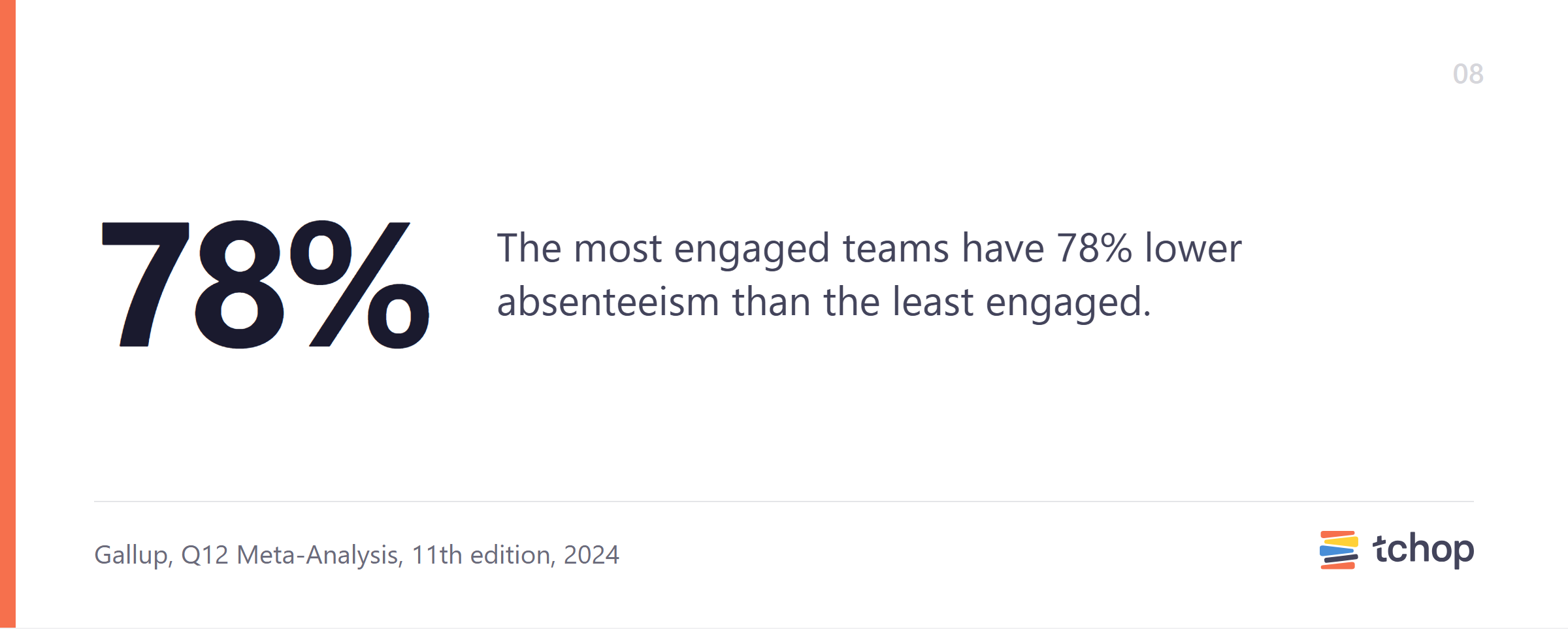
The same meta-analysis found a median difference of 78% in absenteeism between business units in the top and bottom quarters for engagement, and a 63% difference in safety incidents.
Germany shows a similar pattern. Employees with a strong bond to their employer are absent 41% less than those with no bond, according to Gallup’s Engagement Index Deutschland 2025.
Source: Gallup, Q12 Meta-Analysis, 11th edition (published May 2024) · 183,806 business and work units · 90 countries · gallup.com. Germany: Gallup, Engagement Index Deutschland 2025 · 1,700 employees · gallup.com
9. UK employees without regular computer access are 13 points less likely to feel safe speaking up
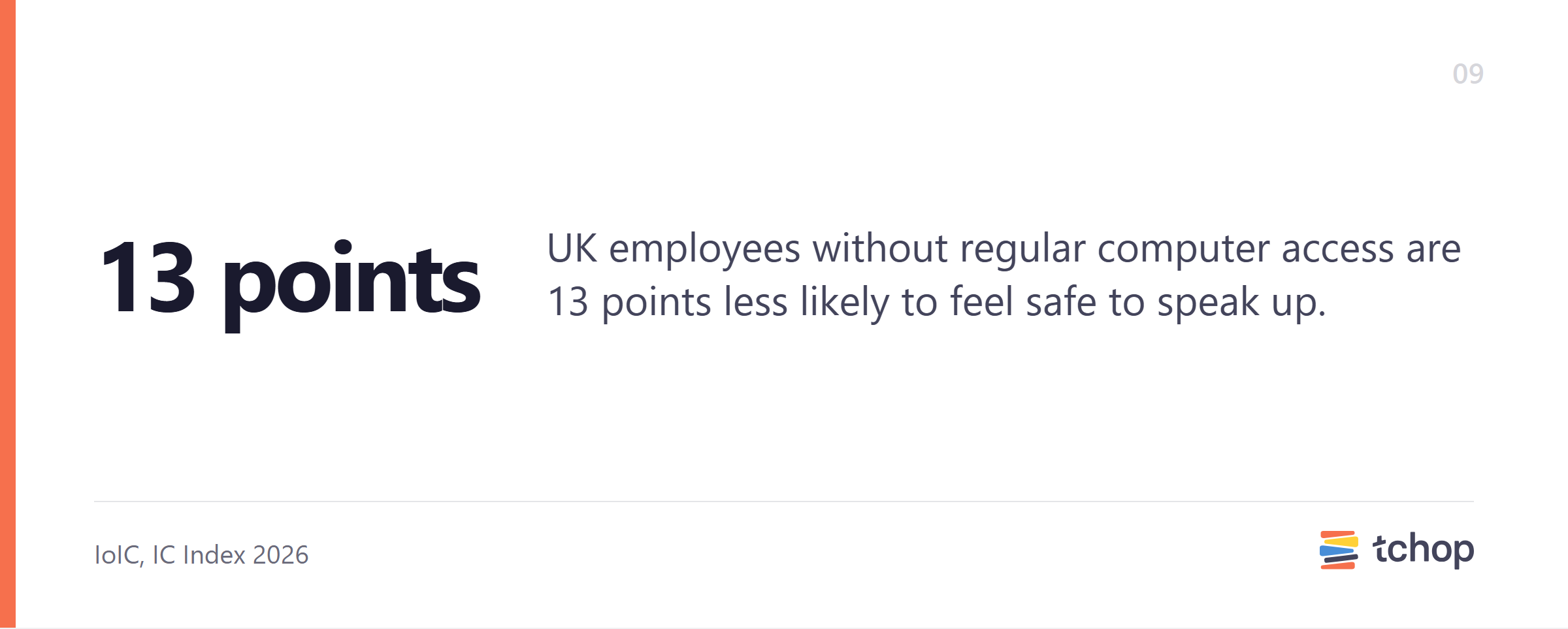
In the UK, 49% of employees agree that people can share their opinion at work without fear of negative consequences. Employees who aren’t regularly connected to a computer are 13 points less likely to feel safe to speak up, according to the Institute of Internal Communication’s IC Index 2026.
Source: Institute of Internal Communication (IoIC), IC Index 2026, with Ipsos Karian and Box · Survey of about 5,000 UK employees in organisations with 500 or more employees · United Kingdom · ioic.org.uk
10. 12% of employees in Germany are actively looking for a new job
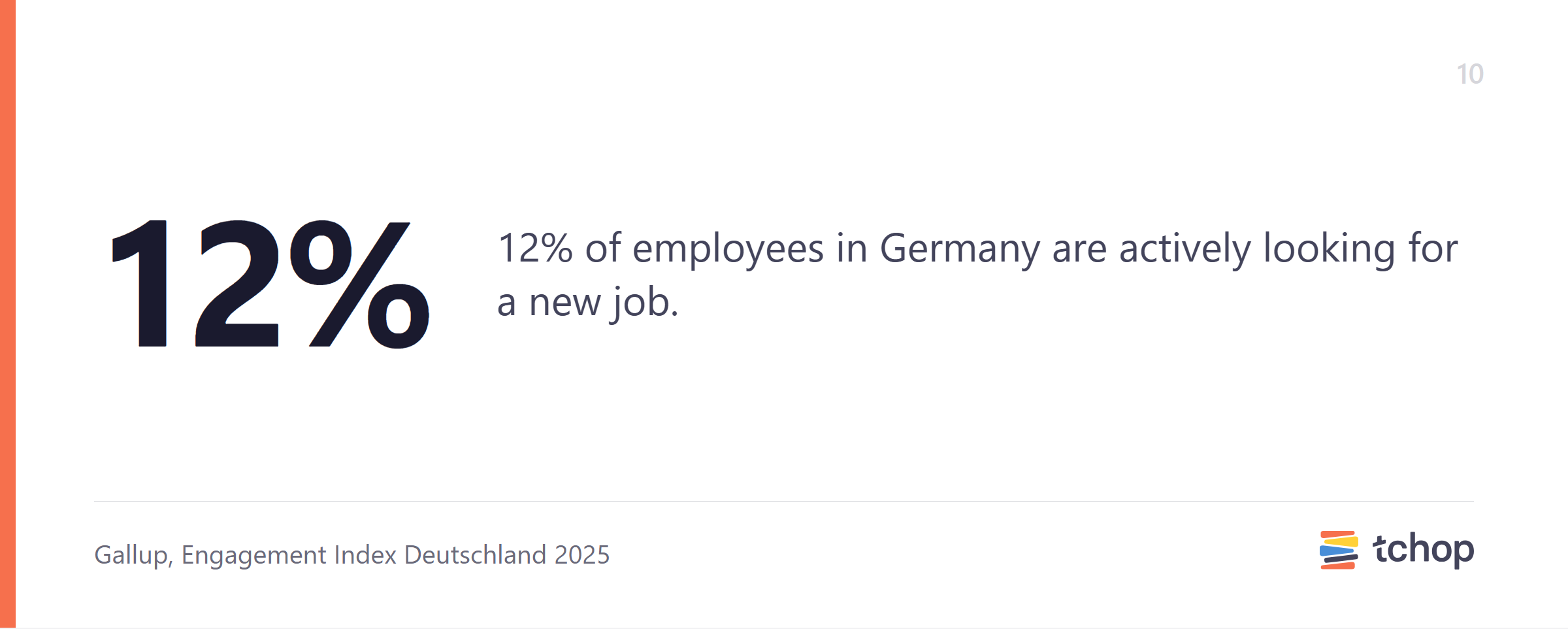
In Germany, 12% of employees are actively searching for a new job, about one in eight. Another 25% say they are open to offers, according to Gallup’s Engagement Index Deutschland 2025.
Engagement makes a big difference here. Only 3% of employees with a strong bond to their employer are actively job hunting, compared with 39% of those with no bond.
Source: Gallup, Engagement Index Deutschland 2025 (published March 2026) · Survey period 17 November to 20 December 2025 · 1,700 employees aged 18 and over · Germany · gallup.com
All statistics at a glance
Data
All statistics at a glance
| Statistic | Figure | Year of data | Sample | Country | Source |
|---|---|---|---|---|---|
| Employees engaged worldwide | 20% | 2025 | 141,444 employed people | Global (140+ countries) | Gallup, State of the Global Workplace 2026 |
| Employees engaged in Europe | 12% | Three years of polling to 2025 | Gallup World Poll | Europe | Gallup, State of the Global Workplace 2026 |
| Employees in Germany with a strong bond to their employer | 10% | 2025 | 1,700 employees | Germany | Gallup, Engagement Index Deutschland 2025 |
| Productivity lost to low engagement | About $10 trillion (9% of global GDP) | 2025 | Gallup World Poll | Global | Gallup, State of the Global Workplace 2026 |
| Managers engaged worldwide | 22% (2024: 27%) | 2025 | Gallup World Poll | Global | Gallup, State of the Global Workplace 2026 |
| Variance in engagement explained by managers | At least 70% | Published 2015 | 2.5 million teams, 27 million employees | 195 countries | Gallup, State of the American Manager |
| Profitability difference, most vs least engaged teams | 23% | Published 2024 | 183,806 business units | 90 countries | Gallup, Q12 Meta-Analysis, 11th edition |
| Absenteeism difference, most vs least engaged teams | 78% | Published 2024 | 183,806 business units | 90 countries | Gallup, Q12 Meta-Analysis, 11th edition |
| Gap in feeling safe to speak up, employees without regular computer access | 13 points (overall: 49% share opinions without fear) | 2026 | About 5,000 employees | United Kingdom | IoIC, IC Index 2026 |
| Employees in Germany actively looking for a new job | 12% (another 25% open) | 2025 | 1,700 employees | Germany | Gallup, Engagement Index Deutschland 2025 |
Employee engagement trends for 2026
Engagement has fallen two years in a row. Compared with earlier editions of Gallup’s employee engagement statistics, the trend is clear. The 2024 report, with data from 2023, put global engagement at 23%. The 2025 report showed 21% for 2024, and the 2026 report shows 20% for 2025. Over the long run, engagement is still eight points higher than in Gallup’s first global measurement in 2009, when it stood at 12% (Gallup).
Managers are squeezed. Manager engagement fell from 31% in 2022 to 22% in 2025, and Gallup says this accounts for most of the recent global decline. In South Asia, Gallup sees signs that organisational flattening, with fewer managers leading larger teams, may be a factor. Best practice shows what is possible: in the organisations Gallup works with most closely, 79% of managers were engaged in 2025, nearly quadruple the global average (Gallup).
Regions are far apart. Engagement ranges from 12% in Europe to 31% in the United States and Canada, based on three years of polling (Gallup regional data). Germany held steady in 2025, close to its lowest level since 2001.
Trust in leadership is fragile. In Germany, only 18% of employees say their company’s leadership makes them enthusiastic about the future, down from 21% in 2024. Only 23% believe their leadership will handle future challenges well, down from 27% (Gallup Engagement Index Deutschland 2025).
AI adoption depends on managers. In Gallup’s survey of US employees in the first quarter of 2026, frequent AI use was much higher when managers actively supported it: 79% compared with 46%. Yet fewer than a third of US employees in organisations that have started using AI strongly agree that their manager actively supports their team’s use of it (Gallup).
Wellbeing and engagement are moving apart. In 2025, 34% of employees worldwide were thriving in their lives, up from 33%, even as engagement fell (Gallup). People can feel fine about life in general and still feel detached from their work.
The cost of disengaged employees
Gallup puts the global cost of low engagement at about $10 trillion in lost productivity in 2025, or 9% of global GDP.
The estimate is built in three steps. First, Gallup uses its survey data to work out the share of engaged, not engaged and actively disengaged employees. Second, it applies the link between engagement and productivity found in its meta-analyses. Third, it uses a standard statistical method, known as utility analysis, to estimate how much more each worker would produce if disengaged employees became engaged, based on each country’s economic output per person. The results for all countries are then added together (Gallup).
Gallup considers the figure conservative, because it leaves out costs such as turnover, safety incidents, theft and healthcare.
For Germany, Gallup estimates the cost of low and missing engagement at between €119 billion and €142 billion in lost productivity in 2025 (Gallup Engagement Index Deutschland 2025).
What the numbers mean for internal communication
Make managers’ communication easier. Managers account for at least 70% of the variance in employee engagement, and their own engagement is falling. One of the most useful things comms teams can do is support them: clear updates to pass on, context they can explain, and a simple way to stay in touch with their teams every day.
Listen as well as inform. Gallup’s German report points out that good managers ask their employees for their opinions and listen to them. Comments, questions, polls and visible answers from leadership turn one-way announcements into conversations. Our glossary explains how employee engagement communication works in practice.
Reach people without a desk. Employees without regular computer access are less likely to feel safe speaking up. In Germany, almost a third of people working in companies with 10 or more staff don’t get internet access for work from their employer (Eurostat, 2025). A setup built only for desk-based staff leaves a large part of the workforce out.
Treat engagement as a retention issue. With 12% of employees in Germany actively job hunting and another 25% open to offers, engagement and turnover are closely linked. Our post on why authenticity in internal comms is the real retention strategy looks at that side of the picture.
FAQ
What percentage of employees are engaged?
Worldwide, 20% of employees were engaged at work in 2025, according to Gallup’s State of the Global Workplace 2026. Regional differences are large: 12% in Europe compared with 31% in the United States and Canada. In Germany, Gallup measures engagement as an emotional bond, and 10% of employees have a strong one.
How much do disengaged employees cost?
Gallup estimates the global cost at about $10 trillion in lost productivity in 2025. For Germany alone, the estimate is between €119 billion and €142 billion. Both figures leave out turnover, safety incidents, theft and healthcare, so the real cost is likely higher.
What are Gallup’s 12 employee engagement questions (Q12)?
The Q12 is Gallup’s employee engagement survey. Its 12 statements cover everyday working conditions, such as knowing what is expected, having the right materials and equipment, being recognised, having chances to develop, and feeling that your opinions count. Employees rate each statement, and Gallup uses the answers to classify them as engaged, not engaged or actively disengaged. Gallup treats the exact wording as proprietary, so it isn’t reproduced here. You can read more on Gallup’s Q12 page.
Which region has the lowest employee engagement?
Europe has the lowest employee engagement of any region, at 12%, according to Gallup’s State of the Global Workplace 2026. The Middle East and North Africa ranks second to last, at 14%.
How often does Gallup publish engagement data?
Gallup publishes its State of the Global Workplace report once a year. The 2026 edition, based on data from 2025, came out in April 2026. Gallup’s Engagement Index Deutschland is also published every year; the 2025 edition came out in March 2026.
Reach every employee, wherever they work
If you’re looking for a way to keep every employee informed and involved, including people without a desk, see how the tchop employee engagement platform works. Book a 20-minute demo.
—