
Sean Griffey, CEO of Industry Dive, recently named something most publishers feel but rarely say. He described four levels of audience relationship: people who have heard of you, people who saw something from you, people who read you, and people who are fans.
The entire publishing industry, he argues, is optimised for level three.
Metrics stop there. Product decisions aim there. Push notifications, editorial calendars, SEO — all of it is designed to get someone to read, subscribe, and come back. Level three is what gets measured. What it misses is the gap between “subscribes” and “cares.”
The metric that changes things
Griffey’s proposed test is reciprocity. Not a dashboard figure.
Would your audience respond if you asked for help? Would they take action for you when there was nothing in it for them? Would they notice if you went quiet?
The creator economy runs on this. Creators share their struggles, ask their communities for things, lean on their audiences in ways that most established publishers consider beneath them. For the few who do it well, those audiences show up — they pay before asking what they’re getting, they defend the creator when things get messy.
You earn attention with a good story or an algorithm hit. Reciprocity takes longer. You build it by being present and useful until the relationship matters to both sides. Griffey is right that you can’t automate a score for it. But you can test it, and the test is simpler than it sounds: ask your audience for something and see what happens.
Why publishers struggle with this
The standard publishing stack is built for distribution, not relationship.
Your CMS publishes articles. Your analytics platform tells you who opened and who bounced. Neither tool is designed to surface the reader who recommends you to colleagues unprompted, or the subscriber who shows up to every live event and brings people. Those readers exist; they are the ones who turn a subscription into a stake. But the infrastructure you use to publish cannot distinguish them from the reader who opened once last November.
You cannot build reciprocal relationships in a channel that only broadcasts.
What reciprocity actually needs
Griffey says the tests for reciprocity have to happen in non-scalable ways. He is right. A direct ask, a community-exclusive event, an early look at something in progress — the specifics vary, but they share one requirement: the reader has to be somewhere that can hear a question and answer it.
A website receives readers. It does not hold them.
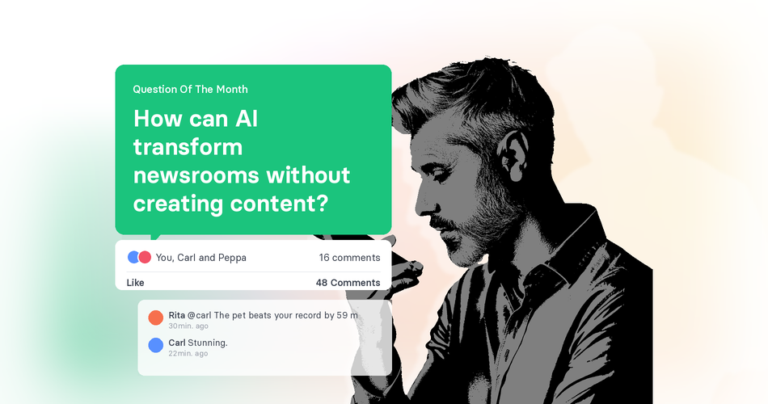
Publishers who are building real reciprocal relationships tend to share a pattern. They have created a space — an app, an owned community, a private channel — where readers can be present over time rather than visiting and disappearing. The content arrives there, but so do the conversations. Readers see other readers. Editors are actual people, not bylines. The publication becomes somewhere you go, not something you consume.
When that environment exists, testing reciprocity gets practical. You can ask questions and get answers, share something unfinished and see who engages, create a moment only available inside that space and watch whether people show up. What you end up with is not a metric — it’s a readership that treats your publication as something worth protecting rather than something easy to cancel.
What to do with this
If Griffey’s framing feels familiar, the first question is not how to measure reciprocity. It is whether you have created the conditions for it at all.
A subscriber list is not those conditions, and neither is a newsletter. Reciprocity needs a place where presence is possible: where a reader can be known, where your team is visible, where the audience exists as a group rather than as isolated data points who never encounter each other.
That is a product decision before anything else. And it is the one that determines whether the reciprocity question is even answerable.
tchop.io gives publishers the platform to build an owned community around their content — where readers can engage, editors can listen, and the relationship has somewhere to live. See how it works