
Sometime this year, humans became a minority on the web. Cloudflare’s radar now counts 57.5 percent of HTML traffic as automated. Most of it is not the spam bots of old. It is AI crawlers and agents reading pages so that people never have to.
That one number breaks the bargain the content business has run on for twenty years. You published in the open, search sent you readers, advertising paid for the work. In 2026, all three parts of that bargain are failing at once, each for its own reason.
The traffic didn’t leave. The people did.
Look closer at the numbers and the picture gets stranger, not simpler. Open web traffic is growing. Agentic traffic, the kind that clicks links and fills out forms, grew 7,851 percent year over year. At the same time, 58.5 percent of searches now end without a single click, because an AI summary answered the question above the first result. Publishers report losing 20, 30, in some cases 90 percent of their referral traffic within a year.
So traffic never fell. It stopped being human. Your servers are busier than ever, but much of what they serve now goes to machines reading on someone else’s behalf, visitors with no memory of you and no chance of ever subscribing.
And the open web is not only losing its audience. It is losing its substance. Nearly 40 percent of the webpages that existed in 2013 are already gone. Content published into the open has a shorter life than most publishers assume, and less of a future.
The reflex is a wall
The industry’s first response is predictable, and it is already happening. Login walls. Bot checks. Pay-per-crawl schemes at the infrastructure level. Cloudflare is building crawler tolls into the plumbing of the web itself. On Reddit, one of the most upvoted privacy threads of the summer put it in sharper terms: the open web is being rebranded as a security risk, and lockdown gets sold as safety.
The instinct behind the wall is correct. Giving your work away to systems that repackage it without sending anyone back is not a strategy. But a wall on its own solves the wrong problem. It protects the content. It does not create a reason to come.
A hard paywall around commodity articles is a toll booth on a road people no longer need to drive. The agent will summarize the story from three other sources, or from your own homepage. The reader who hits the wall bounces, and the relationship ends before it starts.
A toll is not a membership
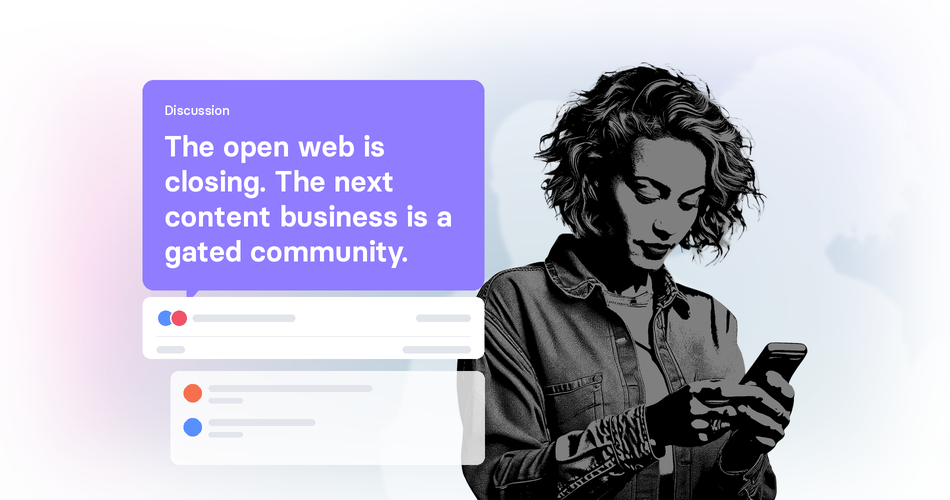
The content businesses that survive this shift will look less like newspapers with better locks and more like gated communities, and the difference between those two ideas carries the whole model.
A paywall charges a toll for an article. A membership opens the gate into a place where people gather, where editors and writers are reachable, where conversations pick up from yesterday and your name means something to the people around you. What sits behind that gate can’t be scraped, because it isn’t content. An agent will summarize your reporting in two seconds, but it can’t hold a reputation among your members, ask a follow-up question in your comment section, or feel anything when an editor takes the time to reply.
You can watch this forming at the edges of the industry already, in newsletters whose reply sections matter more than their archives, in niche media that sell access to a circle before they sell a single article, and in local publishers whose real product is the town square they host, with journalism as its anchor. Seen from there, the gate stops looking like a punishment for people who won’t pay. It becomes the boundary that makes an inside possible in the first place.
What the gated community sells
Strip the model down and a publisher inside this shift sells four things.
- Identity and belonging. Members belong to something they can name, and it says something about them.
- Access. To journalists, to expertise, to each other. The scarce good is proximity, not information.
- Continuity. Conversations, threads, and shared references that build on each other, so returning costs less than leaving.
- A direct relationship. You know who your members are, what they read, what they care about. No platform sits between you, and no algorithm change can take them away.
There is a fifth revenue line, and it points at the machines. If agents want your content, they can license it. The emerging shape of the web splits cleanly: paid, structured access for machines, and gathering places for humans. Selling to both sides beats giving everything to one and charging the other.
Where this heads
The open web will not disappear. It will become the shopfront: the marketing layer where you are discoverable, quotable, and citable by both people and AI. The business will live inside, in owned spaces with names, members, and memory.
That inverts twenty years of publishing strategy. Reach was the asset, and everything else followed from it. Now reach is cheap, mostly synthetic, and owned by whoever runs the algorithm or the agent. The scarce assets are the direct relationship and the place people choose to return to. Publishers who rent their audience from platforms were already exposed. The agent era collects on that exposure.
The practical question for any content business is no longer how to win the feed. It is what your gated community would look like: who belongs inside, what access means, what makes returning a habit rather than a decision. The publishers who answer that early will own the one thing machines cannot replicate, which is a room full of people who want to be there.
We built tchop for exactly this shift: owned communities under your own brand, on your own app and web, where the relationship belongs to you and not to a platform. If the open web is closing, the sensible move is to build the place your audience closes into.