
Watch how people actually use digital spaces and you’ll spot something small but telling. They return to certain places before anything prompts them.
Someone opens a news app before the morning briefing’s even landed, almost out of habit, like they’re checking in with a familiar rhythm. There’s no notification waiting, no breaking update, no external nudge. Just something they do, quietly and consistently.
Same thing happens elsewhere. People check in on communities even when conversations have slowed, and employees reopen internal messages days later without anyone asking. No one’s triggering these moments, they just happen.
And none of it shows up in dashboards.
Yet these voluntary returns, the moments where someone comes back entirely on their own, often reveal more than the big visible engagement surges that dominate most attention.
Teams across publishing, communities and internal comms recognize this pattern when they think about it, even if nobody always names it. It’s behaviour that doesn’t quite fit inside the usual measurement frameworks, but it lingers anyway.
And this is where a small question begins to surface, one most engagement models don’t fully answer.
The part existing engagement models struggle to explain
Most of the frameworks we rely on today were built to make sense of visible behaviour. They’re good at charting what people do once they’re already inside a product or platform. Funnels, loops, session maps all help us understand movement we can actually see.
But those quiet returns from before? They sit slightly outside that view. Don’t follow the usual pattern of trigger, action, reward. They begin before any measurable step has taken place, which is why they tend to slip through the cracks.
Because the models were just never designed to interpret what happens before activity starts.
You notice this most clearly in moments where nothing new has happened. A reader opens an app before a story updates. And similar patterns appear in other environments too, whether it’s people checking in on slow-moving conversations or revisiting internal messages without any prompt. These actions sit outside the boundaries of what traditional engagement logic can account for because they’re not outcomes of a prompt, not reactions to novelty, not completions of a cycle. Something else entirely.
And because they don’t map neatly to the tools we have, we often don’t pause to ask what they might reveal. But the pattern keeps showing up across audiences, across contexts, across completely different types of digital environments, which makes it hard to dismiss as noise or randomness.
Maybe the way we’ve been looking at return behaviour is only part of the picture. Maybe a different lens could help make sense of what motivates people to come back entirely on their own.
Return behaviour as a search for coherence
Every now and then, when you look closely at patterns that don’t sit comfortably inside the usual explanations, a slightly different interpretation starts to emerge.
One way to look at those unprompted returns is to treat them as moments where someone’s trying to steady themselves, where they’re looking for a bit of clarity, connection or alignment before carrying on with whatever they’re doing.
If you take that view, return behaviour becomes less about repetition or habit and more about coherence. Not in a technical sense but in a human one.
You could call this a kind of a “Coherence Field.” A way of describing the subtle forces that seem to pull people back to certain places even when nothing’s demanding their attention.
When you look at it that way, three broad forms of coherence tend to show up. We’ll explore each of these forms next. Each one plays out differently but together they help explain why people come back even when no one asks them to.
What people look for when they come back
Those quiet, unprompted returns tend to cluster around certain conditions. Not rules or formulas but the kinds of signals that make a space feel steady enough to revisit. Three of them show up often enough to pay attention to.
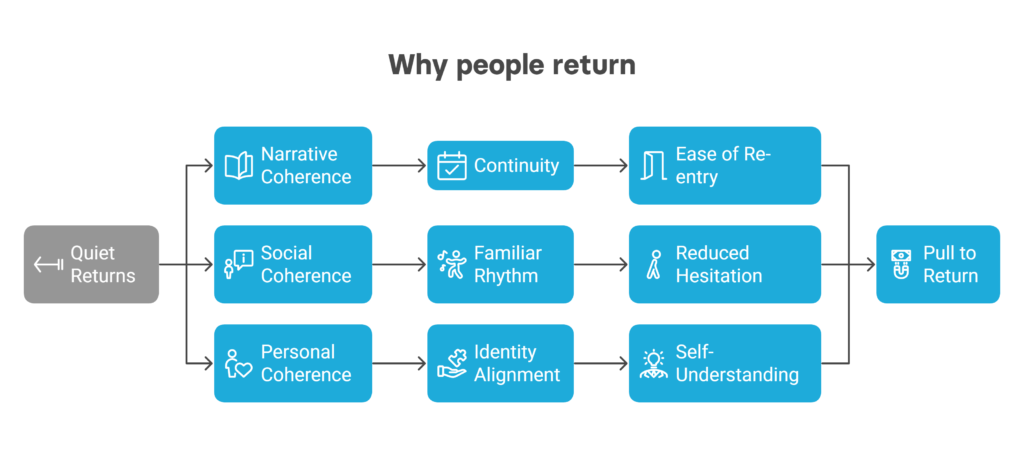
Narrative coherence (when the storyline holds together)
One of the simplest reasons people return is continuity, the feeling that a place doesn’t throw you back to zero every time you show up. In news, you see this in formats that build rather than restart, like a live blog unfolding in real time, an ongoing thread that stitches updates together instead of scattering them across disconnected posts.
When a storyline holds its shape, re-entry takes less effort because you don’t need to rebuild context from scratch and that ease becomes its own kind of pull.
This pattern isn’t unique to journalism. Communities and internal channels have their own versions of continuity, different surfaces but the same underlying need for a story that doesn’t keep resetting.
Social coherence (when the relational rhythm feels familiar)
Another kind of pull comes from the social atmosphere of a space. You see this clearly in places where conversation has a recognisable cadence.
A comments section shaped by a steady editorial presence or a regular Q&A pattern that signals what kind of exchange will unfold.
Familiarity in the social layer removes hesitation and people return because they know how to move within the environment without second-guessing themselves.
Personal coherence (when returning helps you understand yourself)
The deepest form is the one that has little to do with content or conversation and everything to do with identity.
A publication, for example, can become a reference point for how a person makes sense of events, a steadying voice that fits their way of looking at things, so returning feels less like consumption and more like orientation.
Other environments invite the same kind of alignment. The surface differs but the underlying pull is the same, the space helps someone remember who they are, what they value or what matters next.
Once these forms of coherence become visible, the quiet returns from earlier start to look less like anomalies and more like signals, subtle but consistent enough to design for with intent.
Designing for coherence instead of engagement
If those quiet returns are connected to coherence, the practical question becomes how environments actually create it.
In news, you see this most clearly in formats that hold their shape over time. A morning briefing that returns with the same cadence each day or update rhythms that help people re-enter the story without having to replay everything from the start. When the narrative frame stays steady, readers don’t have to fight their way back in because the space meets them where they left off.
The same principle carries into other kinds of digital environments, even if the surfaces look completely different. What matters isn’t the specific format. It’s the sense that the place keeps its footing, that the story doesn’t scatter, the rhythm doesn’t lurch and the voice doesn’t shift tone unpredictably. When a space holds steady like that, people find it easier to return.
Coherence works like that, subtle and nearly invisible but strong enough to pull people back without needing to ask. And once you start seeing those returns through that lens, it becomes easier to understand what they’re signalling, not about the platform, but about the person who keeps coming back.
A final thought on why people return
Some behaviours don’t need much noise to be meaningful. The way people return to certain places, even when nothing has changed, is one of them. It’s not dramatic, and it rarely signals anything as heavy as loyalty. It’s something softer, almost instinctive.
Often, those small returns look less like commitment and more like an attempt to find their footing again. A place that offers a bit of order in the middle of whatever they’re navigating.
Seen that way, return behaviour becomes less about how strongly someone feels tied to a platform and more about how clearly they can orient themselves when they step inside it. That orientation doesn’t need to be dramatic, it might be as simple as “I know where I am here, I know how this space works, I know what this gives me.”
Coherence works gently like that, not as a strategy or a mechanism, but as a quality that makes a place easier to re-enter without hesitation.
And this is only one way to look at it. Not a rule, not a theory meant to replace anything else, just a lens that helps illuminate a behaviour most teams already see but rarely stop to examine. A way of paying attention to the quiet moments, the ones that don’t make charts move but still carry meaning for the people who keep coming back.