
Employee apps got good at targeting messages by role, location, and team. It helped. But relevance has a second engine most apps never switched on: letting employees decide for themselves.
Global employee engagement fell to 21 % in Gallup’s 2025 State of the Global Workplace report. Ask internal comms teams what is dragging it down, and communication overload surfaces fast: too many channels, too many updates, too much that has nothing to do with the person receiving it.
The usual response is to send less. Trim the content calendar, cut the all-staff broadcasts, tighten who is allowed to post. It helps at the edges. It does not solve the problem, because volume was never the whole problem.
The real problem is relevance. And relevance runs on two engines. One is the organisation deciding what reaches whom. The other is the employee deciding what they want to see. Most employee apps run the first engine hard and leave the second one switched off.
What targeting already solved
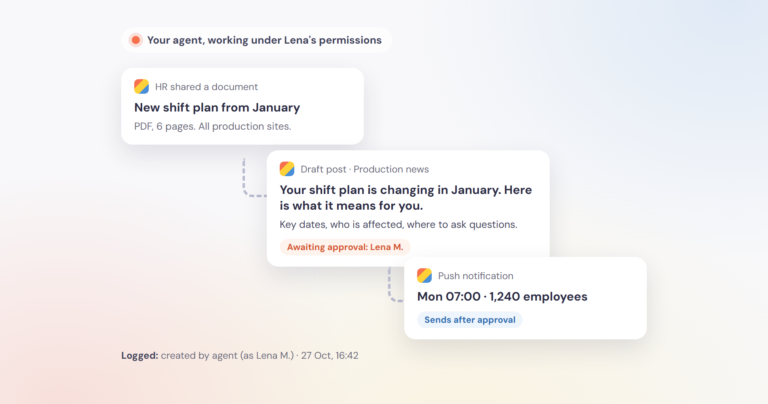
The past few years of employee apps have been a quiet win for the first engine. Instead of every post going to every employee, messages now route by attributes the organisation already holds: role, department, location, language, shift. A safety update reaches the plant floor and skips head office. A benefits change goes to the country it applies to. Newer systems add automation on top, ranking and scheduling content so the right segment sees the right thing at a sensible time.
This works, and the reason is worth saying: a message that does not apply to you is noise, and noise is what erodes attention. Cut the messages that were never meant for someone, and the ones that were land better. Targeting turns a broadcast into something closer to a briefing.
Where targeting runs out
Targeting has a ceiling, and it is built into how it works. Every routing rule is the sender’s guess about what matters to the receiver. That guess is only as good as the data behind it, and the data is mostly org-chart data: where you sit, what you do, who you report to.
Plenty of what makes a message relevant to you is nowhere in that record. The project you joined last month. The topic you are trying to learn. The internal move you are working toward. The team two floors down whose work feeds yours. An org chart cannot see any of this, so a targeting engine cannot route on it. The sender keeps guessing, and the employee keeps receiving a version of relevance decided by someone else.
That is the part worth noticing. Targeting is personalisation done to the employee, not with them. It reduces noise, but it leaves the person on the receiving end passive. They get a cleaner feed they still had no hand in shaping.
The engine most apps skip
The second engine hands some of the decision back. It lets employees follow the teams and topics they care about, mute the ones they do not, set what arrives as a push and what waits in a feed, and choose the channels worth their attention. It is personalisation as freedom rather than as filtering.
This is the half most tools underbuild, and it is easy to see why. Giving employees control feels like giving up control. Comms teams worry that if people can mute channels, the important message will be the one they mute.
The worry points at something real, but the fix is not to withhold the controls. It is to draw a line between what the organisation must guarantee and what the employee gets to arrange. A recall notice, a policy change, a safety alert: these are the organisation’s to enforce, and they should reach everyone regardless of preference. Almost everything else is the employee’s to shape.
Freedom and control are not opposites
Set up that way, the two engines stop competing. The organisation keeps the reach it needs for the messages that cannot be missed. The employee gets a feed that reflects their working life, not just their row in the HR system. Control and freedom sit in the same product, each doing the job the other cannot.
The benefit runs both directions, which is the point people miss when they treat personalisation as a single feature. For the organisation, it means the critical message stops competing with forty things nobody chose to receive, so it lands. For the employee, it means the app feels less like a channel pointed at them and more like a place they have a say in. Relevance the organisation controls, and relevance the employee chooses, are both relevance. An app that only offers one is doing half the job.
Disclosure: this is the principle we rebuilt tchop’s personalisation around. The organisation keeps its targeting and its guaranteed reach. On top of it, the employee gets full control over the rest of what they see, follow, and are notified about.
The question underneath communication overload was never how to send less. It was who gets to decide what lands. For years the only available answer was the organisation. The better answer is both of you.