How podcasts, newsletters, RSS and social content can live together – without feeling messy

Most organisations don’t suffer from a lack of content.

They suffer from content being spread across too many places: podcasts live on one platform, newsletters in inboxes, social posts on half a dozen networks, articles on websites, links in chats. Audiences are expected to jump between all of them — and often don’t.

A modern curation stack exists to solve exactly this problem: not by producing more content, but by bringing relevant external content into one coherent experience.

Why external content belongs in your own platform

Whether you’re a publisher, a brand, or an internal communications team, your audience already consumes content far beyond what you create yourself. Industry podcasts, expert newsletters, partner articles, or a single social post that captures a moment — all of these shape how people understand a topic.

If this content only exists on third-party platforms, you lose context, consistency, and often the relationship itself. Integrating external sources into your own feed allows you to decide what appears, why it matters, and how it is presented.

The goal isn’t to mirror the internet. It’s to curate it with intent.

From links to experiences

Many teams start by pasting links into a feed. Technically that works, but it rarely feels good.

A thoughtful curation setup turns external links into proper content items. Articles have clean previews and images. Podcast episodes appear with titles, descriptions and audio players. Social posts are embedded without platform noise. Each item feels like it belongs — even if it was created elsewhere.

This shift from “sharing links” to “designing experiences” is where curation starts to add real value. And the good news: our platform makes it easy for everyone to integrate any type of content from any source.

RSS feeds: automation with editorial control

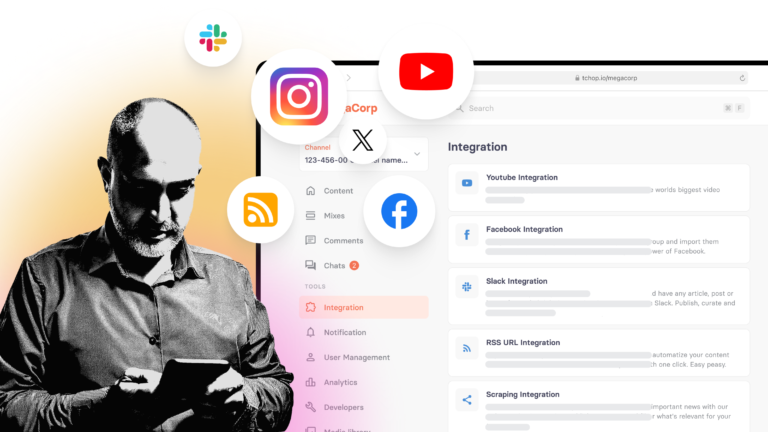
RSS is still one of the most reliable ways to bring in external content. Blogs, news sites and partner publications can flow automatically into your system, where they can be reviewed, tagged and published.

The important part is restraint. Not every item from a feed needs to be visible. Good curation means selecting what’s relevant for your audience and framing it accordingly. When done well, RSS stops feeling like automation and starts feeling like editorial work — just more efficient.

Podcasts as native content, not external detours

Podcast episodes are often treated as outbound links that take users away from your platform. But they don’t have to be.

By pulling in episode metadata — title, description, cover image and audio — podcasts become first-class content. Episodes can sit next to articles, be discussed in comments, or be pushed to users who care about a specific topic.

This changes how podcasts are perceived: from something “over there” to something that’s part of an ongoing conversation.

Newsletters without inbox overload

Newsletters are a goldmine of insight, but inboxes are already full. Curating newsletters into your own platform allows you to highlight the few editions or ideas that truly matter.

Instead of reposting entire newsletters, the focus shifts to relevance. A short intro explaining why a specific insight is worth attention often adds more value than the original mail itself. Over time, your feed becomes a trusted filter — not another distribution channel fighting for attention.

Social content, curated on your terms

Social platforms are excellent at surfacing moments, opinions and signals — but terrible at providing calm, focused environments.

When social posts are curated into your own feed, they lose the surrounding noise. What remains is the signal: a video worth watching, a quote worth discussing, a post that triggered debate. Framed properly, social content stops being fleeting and starts becoming conversational.

The key is selection. If everything is imported, nothing feels important. If only the meaningful pieces appear, the feed gains clarity.

The quiet power of automation

Behind the scenes, automation ties all of this together. External content can be routed through workflows that enrich metadata, apply tags, trigger moderation, or even generate summaries. The result isn’t more content, but smoother processes and more time for editorial judgment.

Good automation is invisible. Users never notice the workflows — they only notice that the feed feels consistent and intentional.

Why this matters long-term

Owning your curation stack means owning the relationship with your audience. You’re no longer dependent on algorithms to surface content. You decide what matters, how it’s framed, and how long it stays visible.

In an environment dominated by platform noise, curation becomes a form of trust. When people return to your app or community, it’s because they know the content has already been filtered with care.

That’s the real value of integrating external data sources: not efficiency, but coherence.

Last Update: February 4, 2026