
Most newsrooms operate as if the hard work ends when a story goes live. The routine is predictable: publish article, push link to social, send newsletter, watch analytics spike briefly then flatten. By morning, you’re onto the next batch of headlines hunting another window of attention. It’s efficient, familiar and feels productive.
But that workflow trains teams to treat engagement as accidental rather than deliberate. The thinking goes: attention equals connection, clicks mean interest, reach signals relevance. If people opened the article, the relationship is fine. If they didn’t, blame distribution or timing. Almost never do we ask whether the product itself is worth returning to unprompted.
The disconnect is that readers don’t experience your journalism the way dashboards describe it. They’re not evaluating stories as isolated events. What they’re actually experiencing is whether your newsroom consistently helps them understand what’s happening without demanding too much effort. They notice patterns, rhythm and whether you feel like a reliable presence in their routine.
Real loyalty gets built in quiet moments, not traffic spikes. It happens when someone opens your app unprompted, trusts your briefing without cross-checking elsewhere or turns to your publication during breaking news. These behaviours rarely show up in standard metrics but they’re the strongest signals of connection you can earn.
That’s why reader loyalty can’t be bolted on after publishing. It has to be designed into how you structure stories, surface content and build routines. Not as a quarterly growth tactic but as a fundamental part of your product. When news becomes routine, relevant and trusted, engagement stops being something you chase and starts happening naturally.
What changes when news is designed as an ongoing relationship
Think this way long enough and something uncomfortable becomes obvious. Most newsroom engagement strategies were never actually designed. They were inherited from print workflows, shaped by platform algorithms, nudged by SEO checklists and rewarded by social media’s obsession with immediacy. Together they created a model where engagement became reactive and fragmented, bolted onto publishing rather than baked in. What looks like strategy is often just old habits rebranded.
The publishers seeing durable growth today treat engagement as a product decision, not a marketing problem to solve after the fact. That means asking harder questions earlier: What does a relationship with a reader look like over six months? Where does familiarity come from? How do you design for trust before traffic? These aren’t questions you answer with a campaign. They shape how your newsroom thinks about its purpose.
When engagement becomes part of product architecture, the focus shifts automatically. Instead of obsessing over how loudly a story travels, you notice whether people return. Instead of chasing daily novelty, you build recognizable formats and rhythms that feel stable. Instead of optimizing every interaction for maximum reaction, you create space for participation that feels optional and human.
This is quieter thinking about growth but it’s more honest. Relationships aren’t built through constant escalation. They’re built through presence, consistency and the feeling that something will be there tomorrow. Newsrooms that understand this stop asking how to squeeze more attention from each story and start designing systems that earn a place in routines through deeper attachment that compounds over time.
Traditional vs. relationship-led newsrooms
Once you think about news as something people return to rather than pass through, the contrast becomes clearer. Traditional newsrooms treat publishing as the finish line. Story goes out, promotion follows, success gets judged by attention captured in a narrow window. Readers are anonymous volume measured by scale.
Relationship-led newsrooms operate differently. Publishing starts a conversation rather than ending one. The goal is returning visitors, not just visibility. Metrics shift from traffic spikes toward patterns that reveal habit and trust. Readers become a known audience with expectations and memory.
Format choices broaden beyond articles. Interaction becomes a design input rather than an afterthought. Distribution shifts from platform dependency toward direct relationships you control.
| Traditional thinking | Relationship-led thinking |
|---|---|
| Publish -> promote | Publish -> invite -> respond |
| Traffic-first metrics | Return frequency and habit |
| Platform dependency | Direct audience relationships |
| Articles as default | Mixed formats with interaction |
| Anonymous readership | Recognizable, familiar members |
| Engagement as outcome | Engagement as design input |
This isn’t about chasing trends. It’s about aligning with how people actually consume and trust information. Readers build loyalty because your product shows up consistently in a way that feels reliable and human.
9 tactics that actually build loyalty
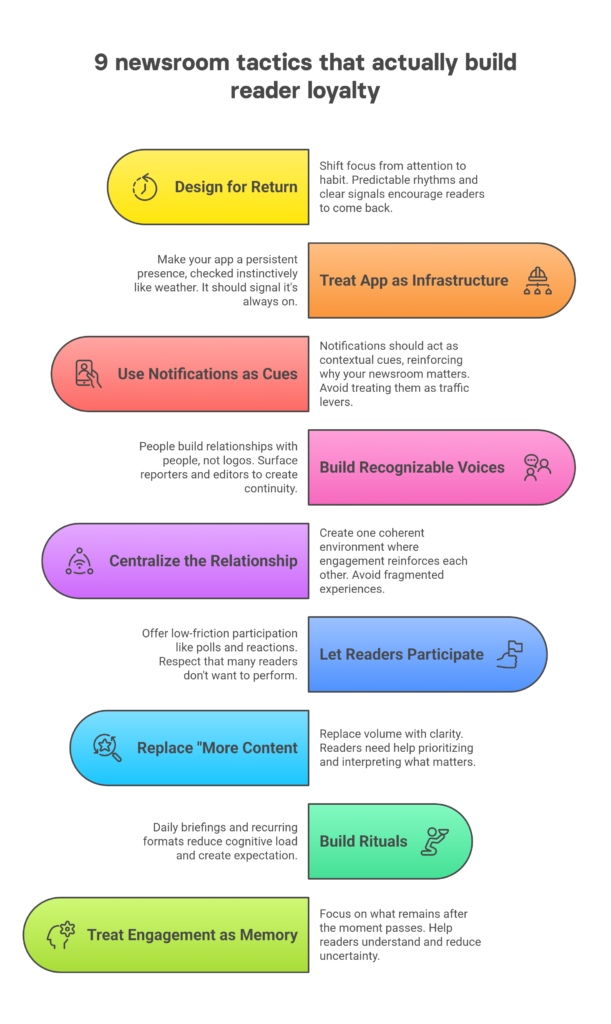
1. Design for return
Most newsroom dashboards celebrate the same metrics they have for years: opens, pageviews, session length, spikes that look impressive in reports. Easy to track, easier to mistake for progress. What they rarely reveal is whether anyone felt a reason to come back.
Loyalty shows up earlier than clicks and far more quietly. It lives in habit rather than reaction, appearing when someone opens your app before a notification arrives or makes your publication the default place they check first. None of that behaviour is dramatic but all of it is meaningful.
Designing for return means shifting focus entirely. Instead of maximizing attention on a single story, you ask what role your product plays in someone’s week. Do readers know when to come back? Do they recognize your formats and rhythms? Does your journalism reduce effort by feeling familiar rather than demanding fresh attention?
Return behaviour feels abstract compared to traffic goals but it’s shaped by tangible decisions: predictable publishing rhythms, consistent entry points, clear signals about what matters today. Products that feel alive even without breaking news.
A useful pressure test: if you stopped promoting content for a week, would anyone show up because checking became routine? Habit beats virality over time. Viral moments create awareness but habits create attachment. When people return unprompted, you’ve earned a place.
2. Treat your app as infrastructure
If your app is just a smaller website, you’re not building a product. You’re shrinking one surface and hoping people adjust. Most don’t.
High-performing publishers treat apps as persistent presences in daily life, checked instinctively like weather or messages even when nothing urgent happened. The value isn’t only what’s new but the reassurance that the newsroom is there.
People don’t open news apps only to consume stories. They open them to orient themselves, to see what changed, to confirm whether something important happened. An app that behaves like a container waits passively. Infrastructure signals it’s always on.
Clear rhythms help readers know when something meaningful appears. Predictable formats reduce cognitive load. Familiar surfaces create comfort. Small signals of life, even on quiet days, remind readers the newsroom hasn’t gone dark.
This is about reducing effort so opening your app feels like a safe, low-friction choice. Readers shouldn’t wonder whether it’s worth checking, they should simply know.
When newsrooms get this right, the app stops being a destination and starts behaving like part of someone’s environment. News gets checked, trusted and woven into routine. Loyalty follows naturally.
3. Use notifications as relationship cues
Push notifications are misunderstood because they’re treated as miniature headlines with urgency cranked up. Something happened so push it out and success gets measured by opens and clicks.
But notifications arrive alongside messages from friends, calendar reminders and work alerts. When everything is framed as urgent, readers feel interrupted rather than informed and that erodes trust far faster than it drives loyalty.
Used well, notifications act as contextual cues rather than traffic levers, gently reinforcing why your newsroom matters right now. A well-timed nudge can remind someone this is where they rely on to make sense of the day, even without an immediate tap-through.
This requires rethinking success. Instead of counting sends or measuring open rates, ask whether the notification strengthened the relationship. Did it feel relevant? Did it respect attention? Sometimes the most effective notifications don’t demand a click at all.
When designed as part of the relationship, notifications become calmer, more intentional and more selective. They show up when they add value and stay quiet when they don’t. Over time, readers learn that when your newsroom reaches out, it’s worth attention.
That trust compounds. Notifications stop feeling like interruptions and start feeling like a familiar tap on the shoulder. Your product becomes part of someone’s day rather than noise competing to be heard.
4. Build recognisable voices
People don’t build relationships with logos, they build them with other people. Trust forms when readers feel there’s a human on the other side whose judgment they recognize and whose voice they’ve learned to understand.
Many newsrooms pursue brand consistency as if it means smoothing out voices until everything sounds the same. The intention is appearing coherent but the result is often the opposite. When everything sounds identical, nothing feels familiar. Readers remember publications because of the people behind the work.
Newsrooms that consistently surface reporters, editors and curators give readers something to latch onto. Familiar names create continuity. Over time, readers recognize how certain journalists explain complex topics or who they trust most for context. That familiarity reduces effort and builds confidence.
This doesn’t mean turning journalists into influencers. It means letting humanity show through controlled ways: short editor’s notes, recurring formats led by the same voices, consistent byline placement. All of this reinforces that real people are showing up.
Bylines are often treated as metadata but they’re relationship anchors, helping readers remember who helped them understand an issue and who they might want to hear from again. When those anchors shift constantly, trust struggles to compound.
Over time, recognisable voices turn a newsroom from an abstract source into a familiar presence. Readers return because they know who they’re hearing from and that human continuity is one of the most durable forms of loyalty you can build.
5. Centralise the relationship
Many publishers still think in terms of distribution rather than experience and it shows in how fragmented the reader journey has become. Articles live on the website, newsletters arrive in inboxes on their own schedule, push notifications interrupt from another direction. From the newsroom’s perspective, this looks like a healthy ecosystem. From the reader’s perspective, it feels like disconnection.
Readers don’t think in channels. They experience everything as one relationship and when that relationship is scattered across tools and platforms, it becomes harder to understand where they belong. That friction quietly erodes attachment even when individual pieces perform well.
A strong news product gives readers one place where the relationship lives, not just where articles are published but where updates arrive, conversations happen and participation feels possible. One coherent environment rather than something stitched together.
This means designing an experience where different forms of engagement reinforce each other instead of competing. Where reading a story naturally leads to seeing how others responded, where updates don’t feel detached, where feedback has a visible home.
When the relationship is centralised, readers stop feeling like visitors moving between disconnected touchpoints and start feeling like they’re inside an ongoing space that remembers them. The product stops behaving like a maze and starts feeling like a home you recognize.
That coherence reduces effort, builds familiarity and makes returning feel natural. In a media environment where attention is constantly being pulled apart, giving readers a single, reliable place to come back to is one of the strongest foundations for long-term loyalty.
6. Let readers participate without forcing performance
Most engagement features fail because they ask too much, too loudly, from too many people.
Comment sections that demand confident opinions, discussion prompts that assume everyone wants to debate, calls to action that treat silence as disinterest. All of this misunderstands how most people actually want to participate. The reality is quieter. Many readers don’t want to perform or argue in public. That doesn’t mean they’re disengaged, just present in a different way.
Low-friction participation respects that reality. Polls, reactions or the ability to follow a topic give readers ways to express interest without turning participation into work. These moments may look insignificant but together they build a sense of being counted and seen.
Participation isn’t binary. For many readers, it’s simply signalling presence, a quiet acknowledgement that they’re paying attention or want to stay close to a topic without stepping into the spotlight.
When newsrooms design only for loud engagement, they exclude most of their audience. When they design for quiet participation, they widen the relationship. Readers stay connected on their own terms without pressure and that autonomy makes returning feel safe.
Over time, these small interactions create familiarity without exhaustion and attachment without obligation. Readers don’t feel pushed to prove engagement. They feel invited to belong and that’s one of the most important foundations for loyalty you can build.
7. Replace “more content” with clearer signals
Overproduction is one of the least discussed yet most damaging patterns in modern newsrooms. Not because journalists are doing poor work but because sheer volume erodes a reader’s ability to understand what actually matters.
When everything is treated as important, nothing stands out. Readers face long lists of headlines, endless feeds and constant updates competing for attention. The result is fatigue. People leave because making sense of it feels like work.
Clarity builds loyalty, not volume. Readers return to news products that help them prioritise and interpret what’s happening rather than forcing them to sift through everything. Curation isn’t a downgrade from reporting, it’s an act of care that signals the newsroom respects their time.
This is where many publishers misread audience behaviour. Declining engagement is treated as a demand problem when it’s actually a signalling problem. Readers aren’t asking for more stories but for help understanding which ones matter right now, how they connect and why they should care.
Clear signals take many forms: fewer, stronger entry points, visible editorial judgment, context that travels with updates. Simple cues like recurring explainers or “what to know” moments reduce effort dramatically.
When newsrooms replace volume with clarity, readers stop feeling overwhelmed and start feeling supported. They trust that opening the app gives them orientation rather than anxiety, making returning easy. Loyalty grows because each interaction leaves the reader feeling slightly more informed and confident about where to come back tomorrow.
8. Build rituals into your product
Rituals are one of the most underused design tools in news, even though they shape behaviour everywhere else. Morning coffee, checking messages before bed. These aren’t daily decisions but rhythms that replace choice with expectation.
News works the same way when designed intentionally. Daily briefings, weekly explainers and recurring formats give readers something to rely on without thinking. They reduce cognitive load by answering in advance: when should I come here and what will I find?
Every time a reader has to decide whether it’s worth opening an app, you’re asking for effort. Over time, that effort becomes a reason not to open it. Rituals short-circuit the decision entirely. People don’t ask whether they should check the morning briefing. They just do because it earned a place in their routine.
Strong rituals work best when they’re stable. Readers know roughly what to expect, who will guide them and how much time it takes. That predictability creates comfort in an otherwise noisy environment.
This isn’t about churning out formats but identifying moments where your newsroom consistently adds value and turning those into reliable touchpoints. Over time, those become anchors that readers orient their week around.
When rituals are built into the product, loyalty stops being something you chase. It becomes part of someone’s life rhythm and once news reaches that level of familiarity, returning no longer feels like a choice. It feels natural.
9. Treat engagement as memory
This is the layer underneath everything else and it’s why many engagement strategies feel busy but still fail to build loyalty. Interaction is visible and easy to count. Memory is quieter, harder to measure and much closer to what readers actually carry with them.
A reader can click ten stories and forget all of them or read one piece and feel something shift in how they understand the world. That second outcome creates loyalty because it gives your journalism staying power beyond the session.
Engagement isn’t about likes, comments or time spent. It’s about what remains after the moment passes. Did the reader feel informed in a way that reduced uncertainty? Did they feel the newsroom anticipated their questions and answered them clearly? Did they feel less confused and more capable of making sense of what’s happening?
When news achieves that, it stops being disposable and starts becoming part of someone’s mental map. Readers remember the newsroom not because they interacted with it but because it helped them think, gave them context or perspective they didn’t have before.
This reframes success. Instead of optimising for maximum reaction, you optimise for minimum regret. You want readers to leave feeling like opening your app was worth it, even if they didn’t comment or scroll for twenty minutes.
News that sticks is remembered. When people remember how your newsroom helped them understand and reduced noise rather than adding to it, they return without being chased. The relationship is built on trust that lives in memory.
A few uncomfortable questions for any newsroom serious about loyalty
By this point, the tactics blur into one bigger idea: loyalty is rarely won through a single feature or campaign but through the everyday experience you create, especially when you’re not actively pushing readers to show up.
These questions pressure test that experience. They’re not meant to be answered in a workshop and filed away but to make you see your product from the reader’s side. If you can answer them honestly, you’ll usually know what needs to change next.
Do readers return without prompts or only when pushed?
Look for the pattern behind the spikes. If opening only happens after a notification, newsletter or social post, you’re buying attention repeatedly. The goal is reaching a place where promotion becomes a boost rather than the entire engine.
Is your app a habit or a backup?
A habit is where someone goes first. A backup is where they go when they remember you exist. The difference shows up in how your app behaves on quiet days and whether it has recognisable entry points that make checking effortless.
Can readers recognise who’s behind the reporting?
If your work feels anonymous, trust struggles to compound. Recognition means consistent voices, visible judgment and a sense that real people are showing up rather than output from a machine.
Is participation optional or performative?
If the only way to engage is commenting or debating, most readers opt out. When participation is designed as a spectrum from quiet signals to deeper contribution, readers can belong without performing.
Are you measuring loyalty or just activity?
Activity can be loud and misleading. Loyalty is often silent. If your dashboards celebrate short-term reaction without tracking return patterns or deepening relationships, you’ll keep optimising for motion rather than attachment.
If even one of these makes you pause, that’s useful. It usually means there’s a gap between what the newsroom believes it’s building and what the reader experiences and that gap is where loyalty either gets designed in or quietly lost.