
The discussion around AI often feels loud, extreme, and slightly detached from reality. Either it will replace everything, or it will destroy what makes human interaction meaningful.
When it comes to community, both views miss the point.
Communities are not workflows. They are not dashboards. They are not engagement funnels. A real community is built on shared identity, recurring interaction, and the feeling of being seen. That does not disappear because AI enters the picture.
What changes is how communities operate at scale.
The intersection of AI and community is not about automation for its own sake. It is about reducing friction, increasing relevance, and allowing community builders to focus on what truly matters: relationships.
What people mean when they search for “AI Community”
The phrase “AI community” is used in different ways. Sometimes it refers to groups of developers or researchers discussing artificial intelligence. Sometimes it describes a platform powered by AI features. And increasingly, it refers to communities where artificial intelligence quietly supports moderation, personalization, and knowledge extraction.
The third category is where things become strategically interesting.
An AI-powered community platform does not replace human interaction. It enhances it. It observes patterns, reduces repetitive tasks, and surfaces insights that would otherwise remain hidden in thousands of posts and comments.
The result is not less humanity. Ideally, it is more space for it.
Why AI is becoming central to community building
As communities grow, complexity grows with them. More members mean more conversations, more content, more signals, and more noise. Without structure, growth can quickly dilute quality.
AI in community building helps manage this complexity.
One obvious area is content curation. In active communities, valuable insights are often buried in long threads. AI can summarize discussions, identify recurring themes, and highlight contributions that deserve visibility. This prevents knowledge from disappearing into the archive.
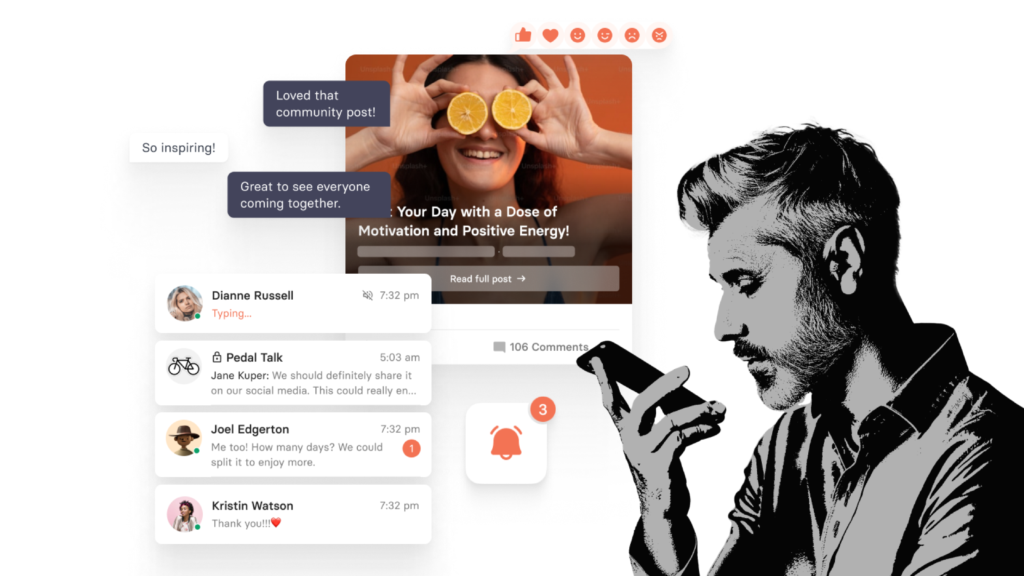
Another area is moderation. As participation increases, so does the risk of spam, toxicity, or subtle forms of disruption. AI moderation tools can flag problematic content early, detect unusual behavior patterns, and support human moderators with context. The key is assistance, not replacement. Communities lose credibility when moderation feels arbitrary or automated without transparency.
Personalization is another powerful use case. Not every member joins a community for the same reason. Some are observers. Some are learners. Some are connectors. AI can recognize patterns of participation and adapt the experience accordingly. That might mean recommending specific discussions, suggesting relevant groups, or inviting someone to contribute based on their expertise.
This is where AI community management moves beyond efficiency. It starts to shape experience.
From engagement metrics to belonging signals
For years, digital platforms have optimized for clicks, impressions, and time spent. But community success depends on something deeper than activity. It depends on belonging.
Belonging is harder to measure than page views. It shows up in recurring participation, peer-to-peer interactions, and advocacy. It shows up when members defend the community in public, invite others, or contribute without being prompted.
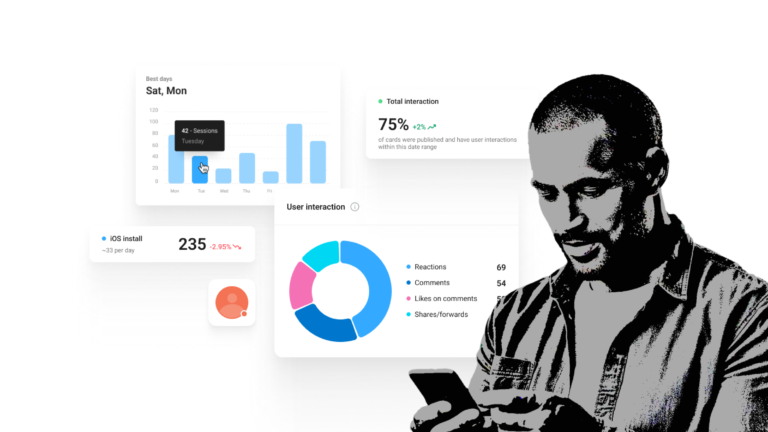
AI can help detect these patterns. It can analyze interaction depth, identify meaningful exchanges, and surface emerging advocates. Instead of looking only at volume, organizations can begin to understand quality.
This is a significant shift. AI is not just helping communities grow. It is helping them understand themselves.
Turning conversations into structured knowledge
Communities generate an enormous amount of collective intelligence. Experts answer questions. Members share experiences. Problems are solved in threads that few people revisit.
Without AI, much of this remains fragmented.
With AI, conversations can be summarized, structured into FAQs, transformed into guides, or turned into searchable knowledge bases. This does not diminish the original discussion. It extends its value.
An AI community can become more than a social space. It can become an evolving knowledge system powered by its members.
For publishers, brands, and professional networks, this is particularly relevant. Communities are not just engagement tools. They are long-term assets.
The risk of over-automation
There is a line that should not be crossed.
When AI generates large amounts of synthetic content, when responses feel templated, or when engagement is artificially stimulated, trust erodes. Members notice quickly when interaction becomes transactional.
The strength of a community lies in authenticity. AI should remove friction, not simulate presence.
That means transparency matters. Members should understand how content is surfaced, how moderation works, and where automation is involved. The more invisible AI becomes, the more important it is that its influence is intentional.
Practical applications of AI in community management
In real-world community management, AI is often less spectacular and more practical.
It supports onboarding by guiding new members through relevant sections. It creates summaries of live chats or events. It helps community managers identify discussions that require attention. It translates content automatically to reduce language barriers. It detects sentiment shifts that may indicate dissatisfaction or conflict.
None of this replaces a community lead. But it reduces manual workload and allows teams to operate with more clarity.
For organizations with limited resources, this is crucial. AI can enable small teams to manage large communities without losing oversight.
Why the combination of AI and community Is strategic
There is a broader context here. Many organizations are trying to reduce dependency on large external platforms. They want direct relationships, first-party data, and environments they control.
Community platforms provide that infrastructure.
AI makes them scalable and intelligent.
Together, AI and community form a powerful combination: ownership of the relationship plus intelligent optimization of the experience.
This is not about hype. It is about long-term resilience.
The future of AI-enhanced communities
Looking ahead, AI will likely become a silent layer in most digital communities. Real-time translation will make cross-border interaction easier. Recommendation systems will become more precise. Predictive analytics may identify churn before it happens. Knowledge extraction will become more seamless.
But the core principle will remain the same.
People join communities to connect, to learn, to feel understood, and to contribute. Artificial intelligence can support those goals. It cannot replace them.
The most successful AI community platforms will not be the ones with the most features. They will be the ones that understand the balance between automation and authenticity.
In the end, AI is infrastructure.
Community is identity.
And identity is what keeps people coming back.