

Most communities do not begin with big plans. They start with a small group of people who keep showing up, where questions get real answers, follow ups do not need fresh context and names quickly become familiar in a way that makes the whole space feel like one ongoing conversation rather than a stream of disconnected posts.
In that early phase, participation feels natural instead of strategic. You can step away and still return to threads that make sense and there is a quiet confidence that whatever you say will be read properly and might shape what happens next. So “engagement” is something the community generates on its own rather than something you have to manufacture.
As the community grows and activity increases, everything looks healthier from a distance. Yet subtle changes begin to show up inside: questions get quick, contained answers instead of unfolding into longer exchanges, familiar voices are easier to miss in the noise and when someone goes silent it takes longer to notice that they are gone.
There is rarely a clear turning point.
Instead, there is a gradual thinning where the space still appears active but the interactions feel lighter and less anchored in shared context, so you can dip in and out without feeling that you have missed anything or that your contribution will carry forward.
It is tempting to label this as maturity and assume that early depth must be traded for scale. Yet what really stood out in the earlier stages was how attentive people were to each other, how much conversations seemed to matter and how showing up carried a quiet sense of responsibility. Which means something real in the way the community works has shifted, even if it is hard to name and the metrics still look good.
What smaller communities get for free
In a smaller, close‑knit community, certain habits just appear on their own, long before anyone thinks about “designing” them or writing them into a playbook. People start to recognise each other because they keep meeting in the same conversations, so you remember how someone framed a problem last time, you recall what they were trying to solve or where they left off and the next time they speak you already have that in your head. Which means the conversation does not need to restart from zero because the context is already in the room.
When that happens, participation feels noticed in a quiet, unremarkable way. Not rewarded, not spotlighted, just seen. A reply reads as if someone has actually taken in what came before, responses build on one another instead of sitting side by side and even when people disagree it still feels grounded. Because it is happening between people who share at least a little bit of history, even if they have never spoken privately or formally.
The rhythm of conversation shifts too. Threads do not rush to a neat conclusion, they pause and pick up again, loop through small detours and someone can come back a day later with something meaningful to add without it feeling late or out of place. Silence has its own weight in this kind of space. When nobody replies, it stands out, because absence is noticeable when you are used to seeing the same people.
None of this asks for heroic effort. It is not the product of clever prompts, stricter moderation or more detailed rules. It happens because the space is small enough for people to hold each other in mind, so continuity lives in the relationships rather than in the systems and the group does not have to lean on tools or processes to remember what is going on.
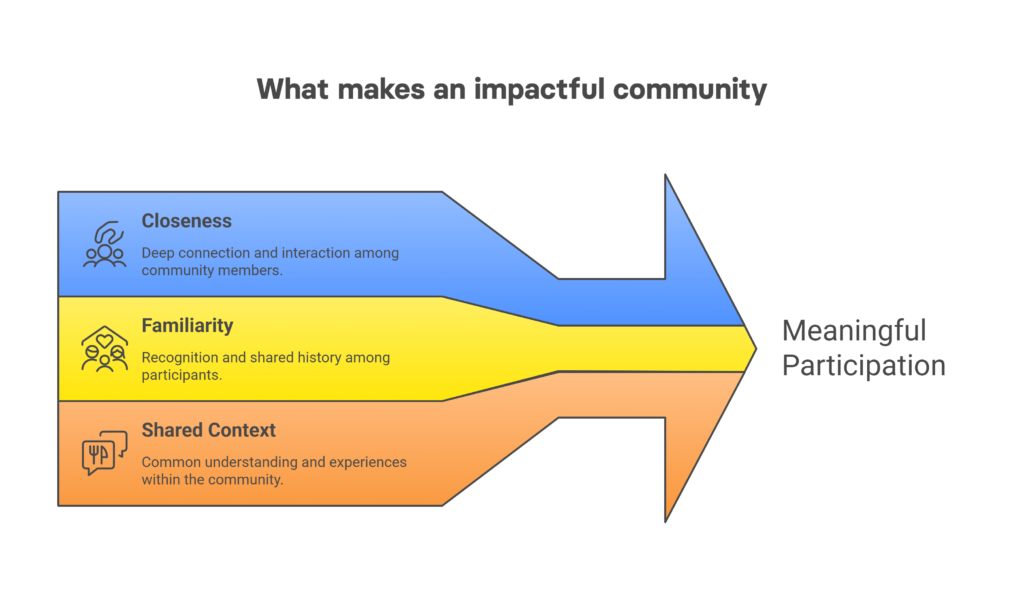
That is also why these behaviours feel fragile when they fade. They were never consciously created or documented, they emerged from proximity and repeated interaction and from the simple fact that it was still possible to keep track of one another without trying very hard. Those conditions are not magical and they are not proof of superior community craft. They are structural and when the structure changes, those behaviours shift with it, even if everything else appears to stay the same.
What changes as communities grow
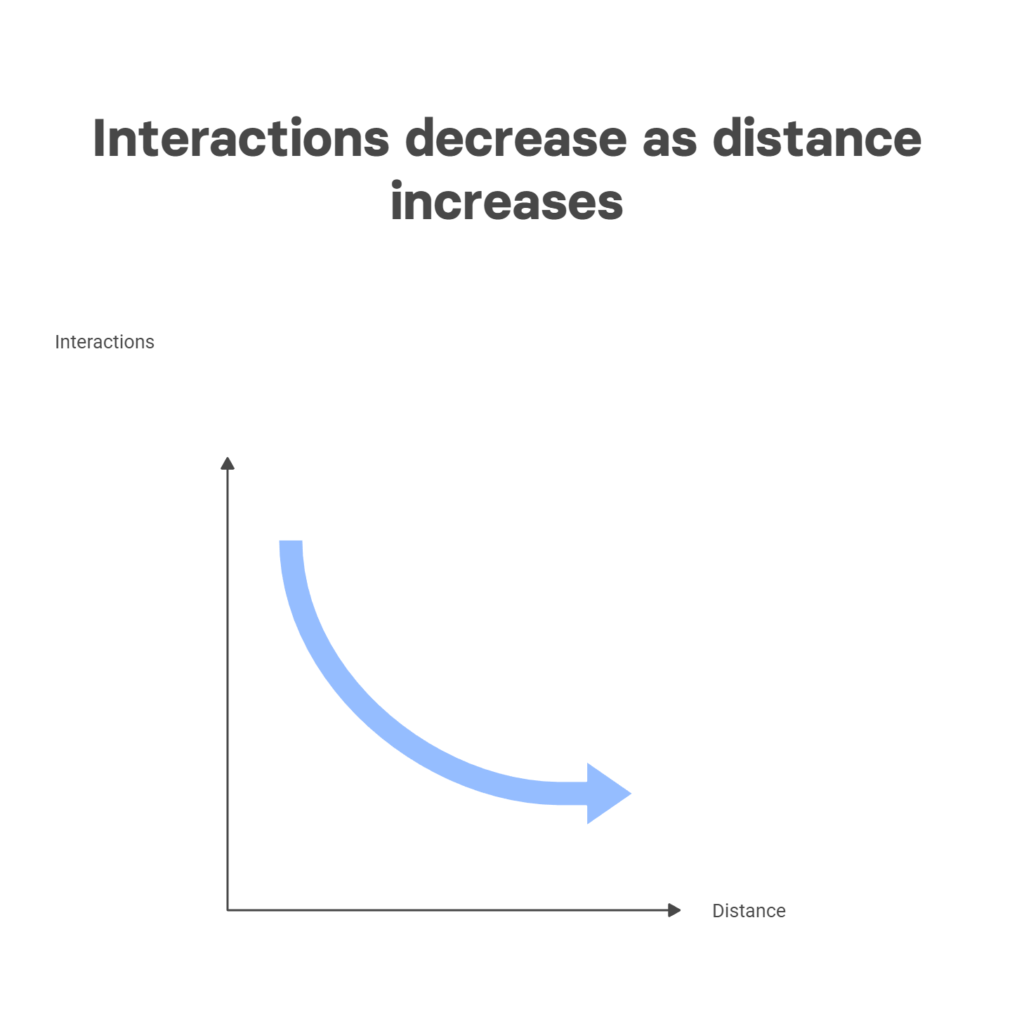
As communities grow, nothing snaps or falls apart, the dynamics simply start to shift in ways that are easy to miss at first. Conversations that once unfolded slowly over days now wrap up more quickly, with questions drawing a few solid responses that stand on their own instead of sparking back-and-forth. Posts feel more like complete thoughts than invitations to keep building together.
Context begins to thin out too. Not in some dramatic way but just enough that people explain a bit more each time. Replies turn general and self-contained and it becomes simpler to jump in without having read the full history, turning the space from one where threads accumulate depth into one that refreshes more like a feed.
Participation changes shape alongside that, with members writing to the room at large rather than directly to each other. Which makes everything more accessible and glanceable but also lighter and less tied to what came before, so reactions come easy but rarely carry the weight of carrying forward.
You see moderation and structure step in more visibly too. As quiet norms that people once carried naturally now need clearer rules and guidance to keep the flow coherent.
From outside it all looks like healthy progress. More posts and quicker responses filling the dashboards, yet inside the sense that each exchange builds on the last starts to fade, leaving growth delivering its numbers while something deeper feels tougher to hold onto.
What became clear across different communities
What stood out was not the communities that stayed small forever but the ones that kept feeling close even as they grew larger. Across spaces built for all kinds of purposes and people, a clear pattern emerged, where depth did not depend on headcount or raw activity but on how near members felt to the conversations and their real outcomes.
In those communities, speaking up still carried weight because responses came shaped by shared context and a natural expectation that threads would continue, leaving traces others could pick up later without anyone needing to prompt them. People referenced past exchanges without rehashing, followed up because they felt part of something ongoing and their feedback landed grounded right inside the flow.
The difference came down to managing distance, not fighting growth itself, since staying connected turned out to be less about keeping everyone in one room and more about creating ways for people to stay close to what mattered to them. Close enough to spot familiar voices, sense shifts and see how their words nudged the discussion forward.
Over time this made one thing obvious. The real challenge lives in those creeping distances from context, from consequence and from each other. So the communities that held their impact simply watched how far people drifted from the heart of the talk and found quiet ways to pull that closeness back within reach.
How larger communities recreate small-community impact
The communities that pulled this off did not try to cram everyone back into one tight space. They gave people spots where they truly belonged, letting smaller, focused groups form naturally inside the bigger whole, grouped around a shared purpose or role or topic that kept pulling the same faces back together.
Inside those pockets, the old magic returned without fanfare. Context stuck around because everyone knew why they were there and who else showed up regularly, conversations picked right up from where they paused instead of rebooting every time and contributing felt lighter since you only needed to reach the handful who actually cared about that thread.
Those subgroups never cut themselves off. They lived right within the larger community, which stayed useful as the hub where ideas bubbled up and people found their way to new corners. But the real depth and continuity happened out on those edges where fewer voices shared more ground.
Over time this setup reshaped the whole feel of the place. The main area turned navigable and breezy without shouldering every heavy lift. While the smaller circles handled the follow-throughs and that lingering sense that yesterday’s words still echoed today.
None of it hinged on shrinking the numbers. It worked by shrinking the distance instead, handing people easy access to the talks that lit them up so attention and real care could slip back in naturally, even as the community kept stretching outward.
When conversations start to carry forward
When communities layer in those smaller pockets the way we just talked about, the shift sneaks up on you without any fanfare or flashing dashboards to announce it. You notice it first in the feel of the place after spending real time there, where conversations stop acting like isolated blips and start behaving like living things with memory.
Topics resurface a few days later without anyone needing to recap from scratch, someone drops a reference to an earlier point and the group nods along because they all remember, threads go quiet then pick back up with everyone knowing right where they left off, so the whole exchange builds a quiet momentum instead of fizzling out.
People jump in on their own too.
Answering questions peer to peer without waiting for a nudge from mods or algorithms. Because they spot the context or recall the story, which puts real help right at hand instead of making it feel routed through a system.
You see it in the returns as well.
Folks circling back because the thread feels unfinished in that satisfying way, slipping in with something that nudges it ahead since they already grasp the lay of the land.
All these moments stack up over time into a richer texture, turning the space from a feed you skim into conversations you own a piece of, where catching up feels optional and speaking up lands with people who actually know you.
From outside nothing looks flashy, just steady hum, but step inside and the difference hits you square, making it tough to ever confuse raw busyness with the kind of impact that sticks.
Why this matters more now than before
It would be simpler if this stayed just a community quirk but the truth runs deeper across all our digital lives these days. Attention scatters thinner and faster than ever, with people skimming feeds, bouncing between tabs and dropping out the second something fails to grab them.
Noise feels like the new normal and anything hoping to hold real care has to fight harder just to get noticed.
That is exactly why sorting activity from true impact counts for so much right now. Because when time stays scarce folks naturally drift toward spots where showing up feels seen and their words land with weight, not the loudest rooms but the closer ones that pull you back without trying.
Growth itself never became the villain here, since most spaces need it to thrive. The real snag hits when scaling amps up distance quicker than it builds bonds, letting easy participation bloom while deeper meaning slips away and being there starts feeling optional instead of something that truly shifts the flow.
The sharpest communities lean into this without nostalgia or panic, embracing scale as fact while tweaking designs to tuck depth where it belongs and keep people near the talks that spark them. They swap raw reach-chasing for closeness-guarding, volume-counting for accumulation-building.
In a landscape packed with ghost towns you glide through traceless, the ones that last make presence matter again, turning quiet continuity into the edge no algorithm can fake.